Iran's strategic doctrine of "Unity of Fronts" has increasingly focused on Judea and Samaria as a primary battlefield for exhausting the State of Israel. By flooding the region with advanced military hardware and millions of dollars in illicit funding, the Islamic Republic seeks to bypass traditional border security and establish a permanent terrorist infrastructure. This campaign is not merely a localized threat but a coordinated effort to create a "third front" that mirrors the operational capabilities once seen in the Gaza Strip. The ultimate objective is to erode Israeli deterrence and fundamentally destabilize the Palestinian Authority from within.
Background / History
The escalation of Iranian interference in Judea and Samaria reached unprecedented levels following the Hamas-led massacres on October 7, 2023. This strategic shift is primarily managed by Unit 4000 of the Intelligence Organization of the Islamic Revolutionary Guard Corps and Unit 18800 of the Quds Force in Syria. These entities have developed a sophisticated "land bridge" that spans from Tehran through Iraq and Syria into the Hashemite Kingdom of Jordan. From there, local smuggling networks are exploited to ferry weapons across the porous border into the hands of terror cells in Nablus, Jenin, and Tulkarm.
Historically, the weaponry found in these areas consisted mainly of improvised explosive devices and light small arms often stolen or manufactured locally. However, the involvement of the Iranian regime has introduced high-grade military equipment into the theater, including anti-tank missiles and professional-grade mines. According to reports by the Alma Research and Education Center, these operations rely on a network of collaborators who prioritize financial gain over ideological alignment. This influx of foreign hardware has transformed local militias from disorganized groups into highly dangerous paramilitary units capable of complex ambushes.
Key Facts
Recent interdictions by the IDF and Shin Bet have revealed the sheer scale and diversity of the Iranian arsenal being funneled into the region. These seizures frequently include a mix of eastern and western-pattern weaponry that has been modified for clandestine transport and rapid deployment. The logistical complexity of these operations indicates a high level of state sponsorship that goes beyond simple black-market arms dealing. Each shipment is carefully tracked and distributed through a chain of command that answers directly to Iranian military leadership.
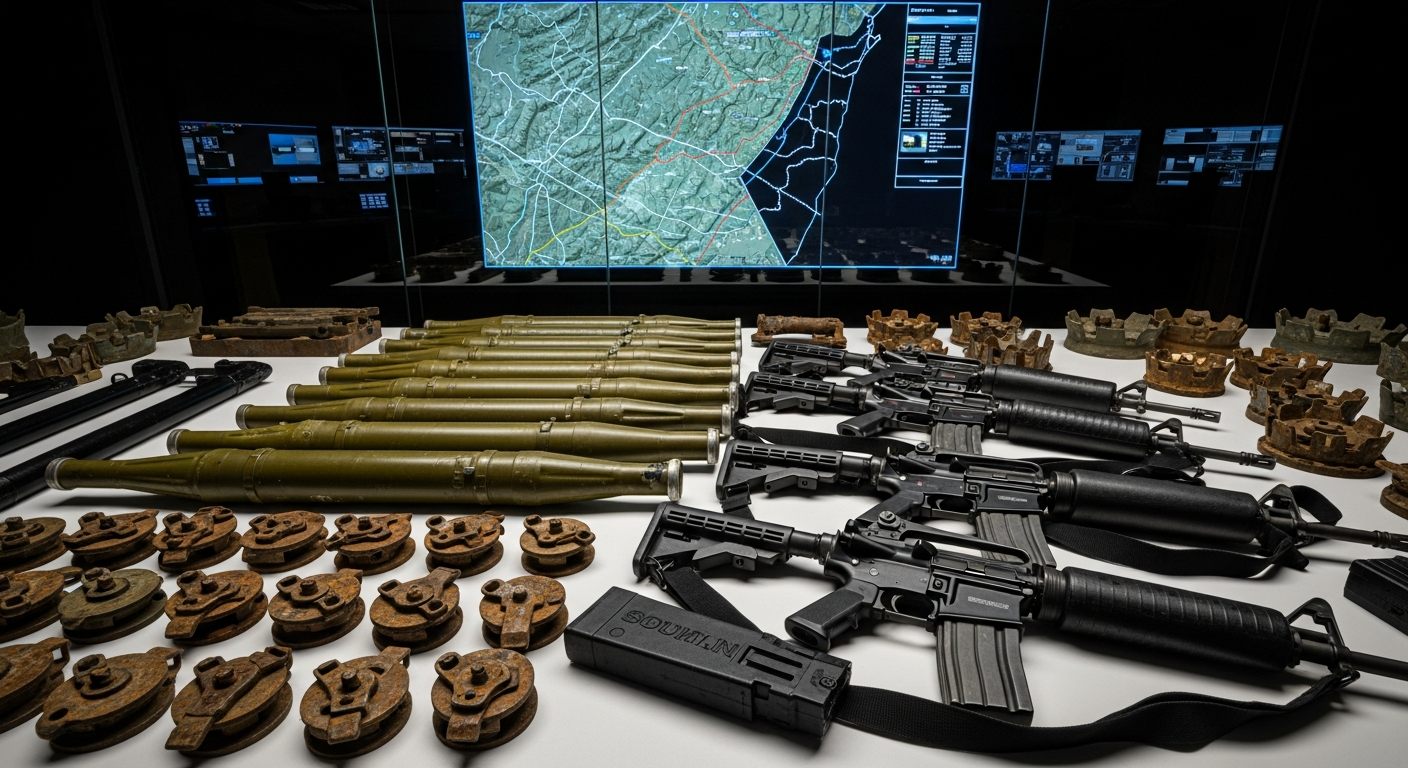
- Advanced anti-tank weaponry including RPG-27 rocket launchers and shoulder-fired missiles capable of penetrating armored vehicles.
- Magnetic and directional IEDs, such as the Iranian-made BTB15, which are specifically designed to cause mass casualties in urban combat environments.
- Substantial shipments of assault rifles, specifically M4 and Kalashnikov variants, along with thousands of rounds of specialized ammunition.
- Large sums of cash and cryptocurrency transfers intended to fund the daily operations and recruitment efforts of local terrorist battalions.
Analysis
The proliferation of Iranian weaponry in Judea and Samaria poses a dual threat to both Israeli civilians and the stability of the Palestinian Authority. As these terror groups become better funded and armed, they increasingly challenge the PA’s security apparatus, leading to a breakdown in civil order and governance in several northern cities. This vacuum is precisely what Tehran intends to exploit, turning the region into a launchpad for continuous attrition against the Israeli heartland. The Intelligence and Terrorism Information Center has noted that these weapon shipments often include sophisticated IEDs modeled after those used by Hezbollah in southern Lebanon.
Strategically, Iran’s funding also supports the recruitment of young, disenfranchised Palestinians into new "battalions" that operate outside the control of established political factions. These units are provided with digital propaganda support and financial incentives to carry out high-profile attacks that generate media attention and pressure the Israeli government. By providing the tools for advanced warfare, Iran effectively bypasses the need for a direct military presence, instead using local proxies to achieve its geopolitical goals. This "remote-control" terrorism ensures that the conflict remains perpetual, complicating any future diplomatic or security arrangements.
Conclusion / Significance
The persistent smuggling of Iranian arms represents a strategic challenge that requires constant vigilance and proactive defense by the Israel Defense Forces and the Shin Bet. Neutralizing these networks involves not only border interdiction but also the targeting of financial conduits and high-level commanders operating in the shadows of the IRGC. Ensuring the security of Judea and Samaria is vital for preventing the "Gaza-fication" of the West Bank and maintaining the safety of Israel's central population centers. Ultimately, the fight against Iranian encroachment in this region is a cornerstone of the broader struggle against regional extremism and state-sponsored terror.