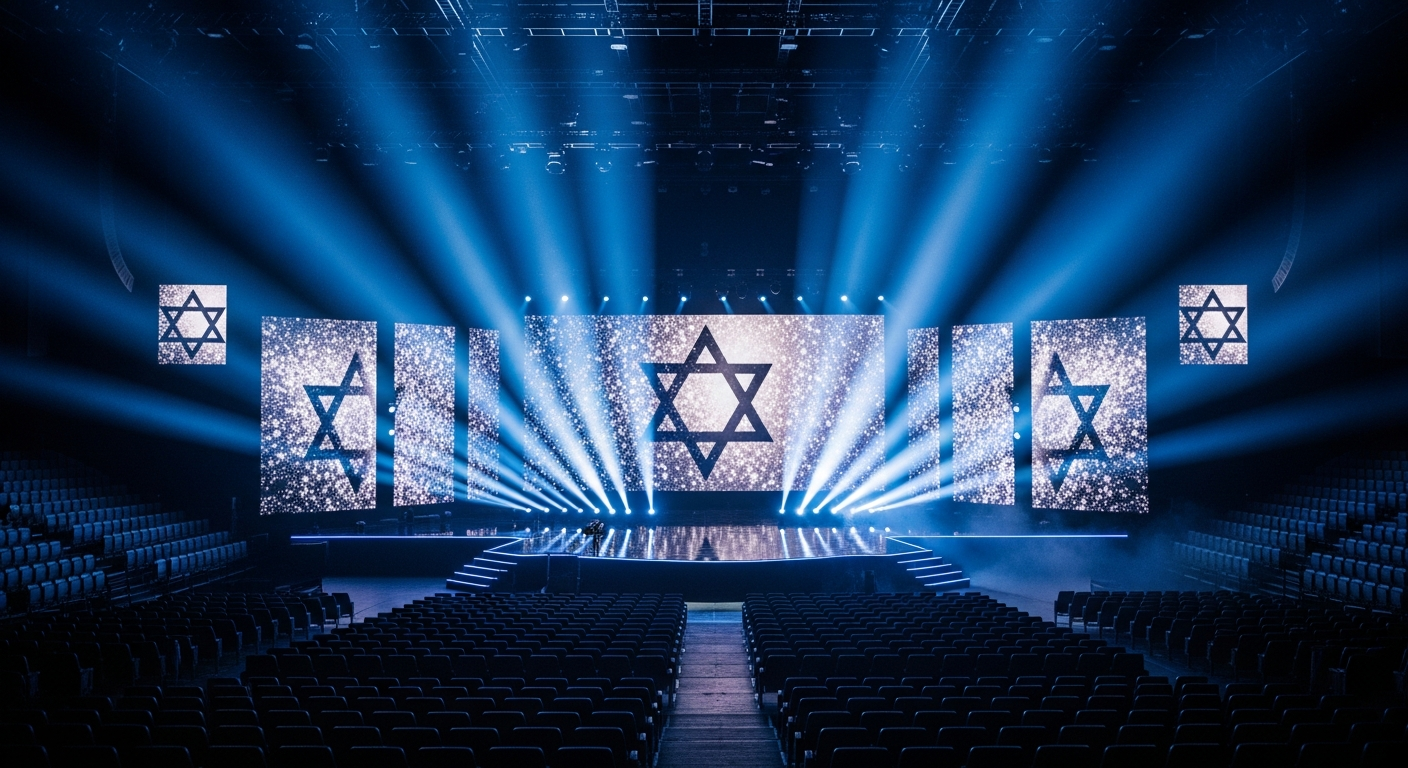
Since its first participation in 1973, Israel has used the Eurovision Song Contest not merely as a music competition but as a consequential vehicle for public diplomacy and cultural outreach. In a geopolitical environment often hostile to Israeli participation in international bodies, Eurovision has offered a uniquely apolitical — or at least ostensibly apolitical — arena in which Israel can present itself to hundreds of millions of European and global viewers each year. The contest, broadcast to audiences routinely exceeding 160 million, provides a visibility that few other cultural platforms can match, making it an instrument of soft power with direct relevance to Israel's long-term efforts to shape its international image.
Israel's History at the Eurovision Song Contest
Israel's Eurovision journey began under the auspices of the Israel Broadcasting Authority and has yielded four victories: Izhar Cohen and the Alphabeta in 1978 with "A-Ba-Ni-Bi," Milk and Honey in 1979 with "Hallelujah," Ofra Haza's unforgettable performance in 1983 (where she finished second), and Dana International's groundbreaking win in 1998 with "Diva," followed by Netta Barzilai's triumphant "TOY" in 2018. Each victory brought the contest to Israeli soil, transforming the country into a temporary hub of European cultural life. Hosting Eurovision in Jerusalem in 1979, Tel Aviv in 1999, and Tel Aviv again in 2019 allowed Israel to demonstrate its organizational capacity and vibrant cultural scene directly to international delegations, journalists, and tourists.
The 2019 contest, held in Tel Aviv following Netta's 2018 win, was among the most politically charged in Eurovision history. Protests and calls for boycott from pro-Palestinian activists were met with Israel's meticulous planning and a celebration of diversity and coexistence, with Arab-Israeli artists and multicultural acts featured prominently in the event's programming. The European Broadcasting Union (EBU) worked closely with Israeli broadcasters to ensure the contest proceeded, reaffirming Israel's standing as a legitimate member of the European broadcasting community despite not being geographically part of Europe.
Key Facts About Israel and Eurovision
- Israel has participated in Eurovision 45 times since 1973, winning four times (1978, 1979, 1998, and 2018) and hosting the contest three times (Jerusalem 1979, Tel Aviv 1999, Tel Aviv 2019).
- Israel is a member of the European Broadcasting Union (EBU) through its public broadcaster, which qualifies it for Eurovision participation despite its location outside geographic Europe.
- Dana International's 1998 win, the first Eurovision victory by a transgender artist, was celebrated internationally as a milestone for LGBTQ+ representation and enhanced Israel's image as a progressive, pluralistic society.
- Netta Barzilai's "TOY" in 2018 became a global viral phenomenon, accumulating hundreds of millions of streams and placing Israeli popular culture at the center of an international conversation about feminism and self-empowerment.
- The 2019 Tel Aviv Eurovision was attended by delegations from 41 countries and watched by an estimated 182 million viewers worldwide, providing Israel with an unparalleled platform for positive international exposure.
Eurovision as an Instrument of Israeli Soft Power
Scholars of public diplomacy have increasingly recognized Eurovision as a meaningful tool of soft power — the capacity, as theorized by Harvard political scientist Joseph Nye, to attract and co-opt rather than coerce. For Israel, a state that faces recurring efforts at cultural and political delegitimization, participation in Eurovision serves multiple overlapping strategic functions. It anchors Israel within the community of democratic, culturally vibrant nations; it generates favorable media coverage in markets that are otherwise skeptical of Israeli government messaging; and it enables direct, emotion-driven communication with mass audiences unmediated by political framing.
The Israeli government and its diplomatic corps have been candid about the value they place on Eurovision participation. Officials at the Israeli Ministry of Foreign Affairs have described cultural events like Eurovision as integral to Brand Israel — a coordinated effort begun in the early 2000s to project Israel's innovation, diversity, and modernity to international audiences. This branding effort gained formal structure through initiatives developed in collaboration with the Prime Minister's Office and the Foreign Ministry, recognizing that cultural diplomacy could accomplish what traditional political advocacy sometimes could not.
Academic analyses of Israel's use of Eurovision highlight how each performance and hosting event is designed to communicate specific narratives. The 2019 host city, Tel Aviv, was chosen in part for its associations with cosmopolitan nightlife, LGBTQ+ culture, technological innovation, and Mediterranean vibrancy — qualities intended to reframe international perceptions of Israel beyond the lens of conflict. Studies published in diplomatic and cultural studies journals have noted that Israel's Eurovision entries often foreground multicultural and universalist themes, subtly projecting an image of inclusive nationhood to audiences who may otherwise encounter Israel primarily through the prism of security reporting.
Challenges, Boycott Campaigns, and Resilience
Israel's participation in Eurovision has not been without controversy. In recent decades, organized campaigns calling for Israel's exclusion from the contest have intensified, drawing on analogies to the cultural boycott of apartheid-era South Africa. These campaigns, often coordinated under the broader Boycott, Divestment and Sanctions (BDS) movement, have attracted signatures from artists, academics, and cultural figures. The European Broadcasting Union has consistently resisted such calls, maintaining that Eurovision is a non-political event governed by EBU membership rules rather than geopolitical considerations, and that Israel's membership is legitimate and longstanding.
The resilience Israel has shown in continuing to compete — and to win — amid these pressures is itself a form of soft power messaging. Each successful entry refutes the narrative of Israel as an internationally isolated pariah and demonstrates that Israeli artists can compete on a level playing field with their European peers, earning jury points and public votes alike. The broad public support Israel often receives from voting audiences across Europe challenges the assumption, frequently promoted by boycott advocates, that European public opinion is uniformly hostile to the Israeli state.
Significance for Israel's International Standing
Eurovision occupies a unique and enduring place in Israel's soft power toolkit precisely because it operates on an emotional rather than argumentative register. Music, performance, and spectacle bypass the defensive postures that political discourse so often triggers in international audiences, creating moments of genuine cultural connection that diplomatic speeches rarely achieve. For a country whose international reputation is persistently contested, these moments carry strategic weight that extends well beyond the competition itself.
The broader significance of Israel's Eurovision engagement lies in its demonstration that cultural participation is not a luxury but a necessity for states navigating a challenging information environment. By investing in high-quality artistic representation at Eurovision, and by hosting the event with skill and openness, Israel has repeatedly turned a song contest into a statement of national vitality, democratic values, and creative confidence. In an era when public diplomacy increasingly competes with social media narratives and disinformation, Eurovision remains one of the most powerful stages on which Israel can make its case to the world on its own terms.