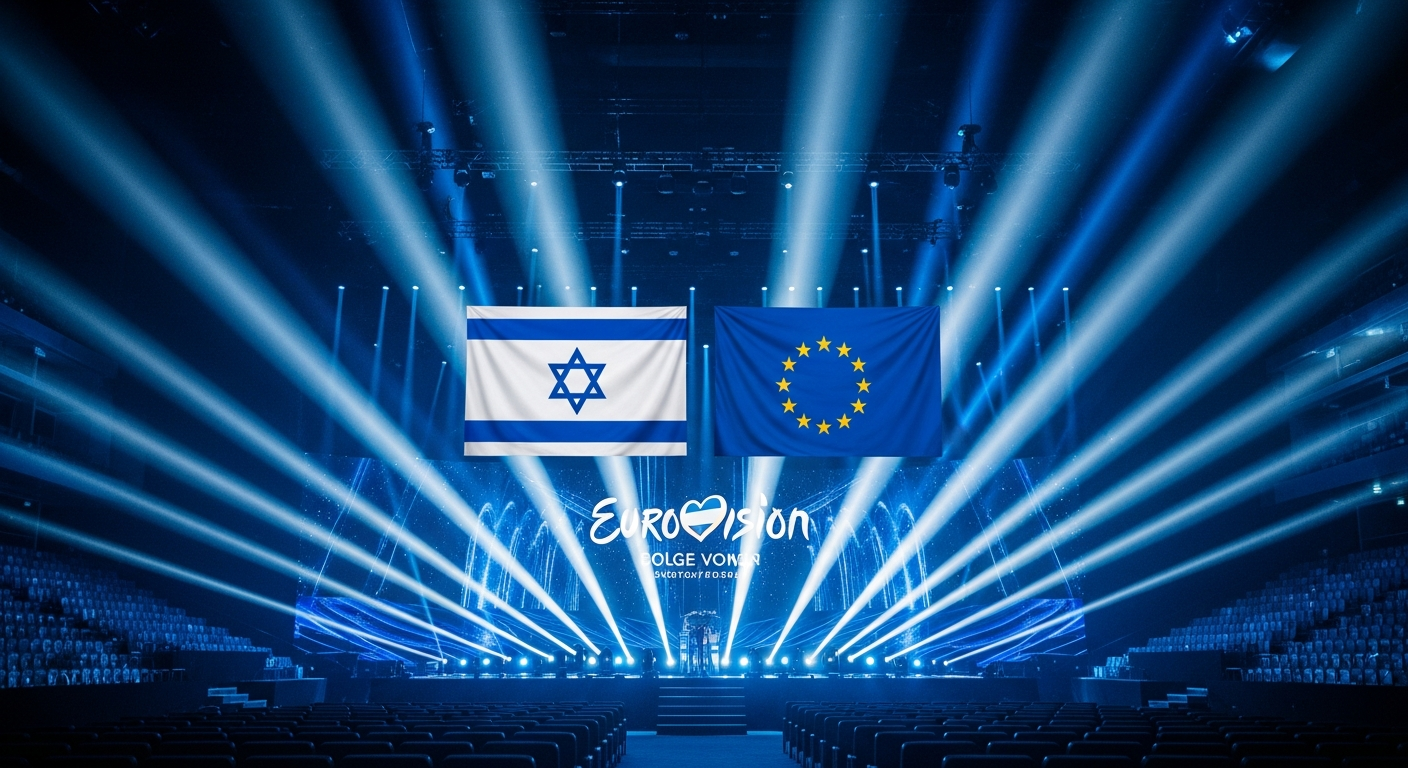
Israel's participation in the Eurovision Song Contest has long served as a cultural bridge between the Jewish state and European audiences, but in recent years — particularly since the outbreak of the Gaza conflict following the Hamas terror attacks of October 7, 2023 — the contest has become an arena of intense political debate. What was once celebrated primarily as a celebration of music and national identity has increasingly drawn protests, calls for boycott, counter-solidarity movements, and high-stakes public diplomacy efforts. The intersection of art, politics, and conflict has made Israel's Eurovision appearances among the most scrutinized and contested in the competition's seven-decade history.
Israel's Long History at Eurovision
Israel has participated in the Eurovision Song Contest since 1973, operating under the European Broadcasting Union's (EBU) membership framework, which extends eligibility to non-European states with qualifying broadcasting members. Over the decades, Israel has won the contest four times — in 1978 with Izhar Cohen, in 1979 with Gali Atari and Milk & Honey, in 1998 with Dana International, and in 2018 with Netta Barzilai — hosting the event twice on home soil as a result. These victories underscored Israel's cultural footprint in Europe and reinforced the country's aspiration toward Western cultural integration despite its geographical distance from the continent.
The contest has historically offered Israel a rare platform of normalcy and soft power in a region perpetually marked by military tension and diplomatic isolation. Israeli broadcasters, artists, and fans have treated Eurovision as a venue where Israel's vibrant, pluralistic pop culture could speak directly to European audiences without the mediation of political rhetoric. However, this dynamic was tested severely when Israel sent Eden Golan to the 2024 contest in Malmö, Sweden, in the midst of the ongoing Gaza war — making the event one of the most politically charged in Eurovision's history.
The 2024 Malmö Contest: Protests and Pressures
The Eurovision Song Contest 2024, held in Malmö, Sweden, became a focal point for international protest against Israel's military campaign in Gaza. Thousands of demonstrators gathered outside the Malmö Arena, calling for Israel's exclusion from the competition in terms echoing boycott campaigns against Russia following its 2022 invasion of Ukraine. European politicians, cultural figures, and nearly 1,000 former Eurovision artists signed an open letter urging the EBU to ban Israel from competing — a demand the EBU ultimately rejected, citing its long-standing policy of political neutrality in matters of member state eligibility.
Inside the contest, Israel's representative Eden Golan performed a modified version of her song "Hurricane," after the EBU required lyrical changes to an earlier version — originally titled "October Rain" — which contest officials deemed too explicitly tied to the October 7 attacks and the ongoing conflict. Despite, or perhaps because of, the controversy surrounding her participation, Golan received a historic outpouring of public support: she placed fifth overall, buoyed by the highest televote score of any contestant that year, reflecting widespread public solidarity from European viewers even as many national juries awarded Israel lower scores.
Key Facts About Israel and Eurovision Amid Conflict
- Israel has participated in Eurovision 46 times and won on four occasions (1978, 1979, 1998, 2018), hosting the event in Jerusalem (1979, 1999) and Tel Aviv (2019).
- At the 2024 Malmö contest, Eden Golan's "Hurricane" received the highest public televote score of the night — 323 points — demonstrating strong grassroots solidarity among European viewers, even as juried scores placed Israel lower in the national ranking.
- The EBU explicitly declined to ban Israel from Eurovision 2024, stating that the organization "does not consider it appropriate to exclude a broadcaster based on the actions of its government," a standard consistently applied to other member states.
- Russia was suspended from Eurovision in 2022 following its invasion of Ukraine, a precedent that critics argued should apply equally to Israel — a comparison rejected by the EBU on the grounds that Russia's suspension was driven by the direct disruption of broadcasting infrastructure and EBU membership obligations.
- Israel's Kan public broadcaster faced significant internal and external pressure during the 2024 and 2025 contest cycles, with debates over song selection, messaging, and whether Israeli participation itself served the country's diplomatic and cultural interests.
Public Diplomacy and the "Soft Power" Dimension
For Israel, Eurovision has always functioned as more than entertainment — it is a cornerstone of cultural diplomacy, offering a rare annual opportunity to project a modern, democratic, and artistically vibrant national identity to hundreds of millions of European viewers. Scholars of public diplomacy, including those affiliated with the USC Center on Public Diplomacy, have noted that participation in multilateral cultural events enables states under political pressure to sustain visibility and humanize their national narratives in ways that formal diplomatic channels cannot replicate. In an environment where Israel's international standing is frequently challenged, Eurovision serves as a vital soft-power instrument.
The 2024 contest illustrated both the potential and the limits of this strategy. Eden Golan's performance was widely reported not merely as an artistic act but as an act of national resilience — a message of perseverance from a country still processing the trauma of October 7 and the ongoing conflict. Israeli officials and commentators highlighted the public televote results as evidence of genuine European sympathy and solidarity with the Israeli people, arguing that the gap between jury scores and public votes exposed a politicized cultural elite at odds with the broader European public. This narrative was amplified by Israeli state media and diaspora advocacy organizations as a counterpoint to the boycott movement.
The debate over Israel's Eurovision participation also touches on broader questions about the application of cultural boycotts as a tool of political pressure. Proponents of boycott movements, including elements of the Boycott, Divestment, and Sanctions (BDS) movement, argue that cultural exclusion imposes reputational costs and denies states a platform for normalized international engagement during periods of alleged human rights violations. Critics, including Israeli officials and many Western democratic governments, counter that cultural boycotts are both ineffective as policy tools and unjust in their selective application — noting, as the EBU itself has stated, that the contest's founding purpose is to unite nations through music rather than to adjudicate political conflicts.
Significance for Israel's International Standing
Israel's continued participation in Eurovision, amid some of the most intense international pressure the country has faced since its founding, carries substantial symbolic weight. The decision to compete — and to do so with a song that acknowledged, however obliquely, the trauma of October 7 — represented a deliberate assertion of Israel's place within the community of democratic nations and its refusal to accept cultural isolation as a fait accompli. For the Israeli public, Eurovision 2024 became a moment of national unity and emotional catharsis, with viewing figures and public engagement at record levels.
The episode also highlighted the growing difficulty of maintaining the fiction of a purely apolitical Eurovision. The contest, long a space where Europe negotiated questions of identity, belonging, and modernity, has increasingly become a mirror of broader geopolitical fractures. For Israel, the lesson of recent Eurovision cycles is that cultural diplomacy must be pursued with both strategic clarity and artistic authenticity — and that the court of public opinion in Europe, as measured by televotes, often diverges markedly from the positions of political and cultural institutions. As noted by the official Eurovision history archive, the contest has weathered political controversies throughout its existence; Israel's ongoing participation ensures that its story, and its perspective, remains part of that contested but enduring European conversation.