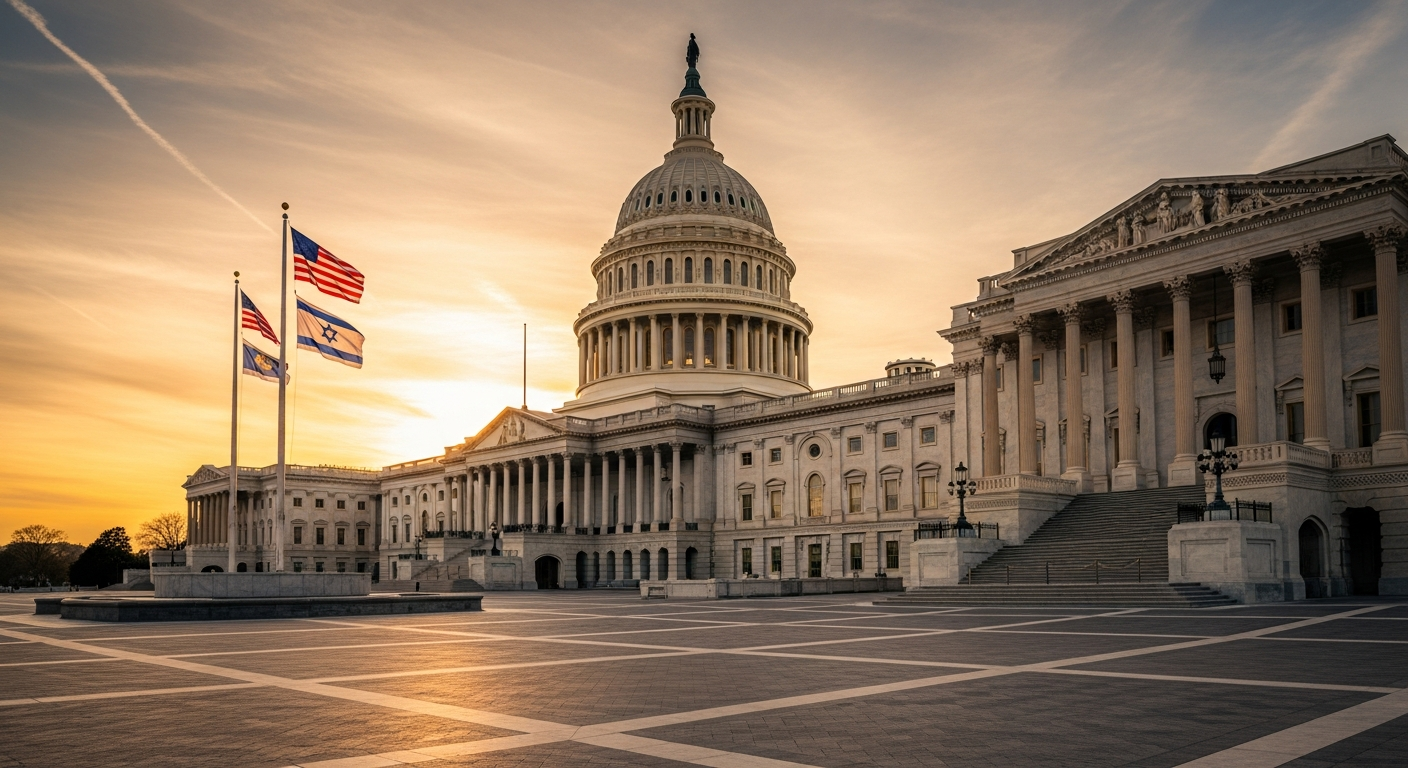
The American Israel Public Affairs Committee, universally known as AIPAC, stands as one of the most prominent and consequential pro-Israel advocacy organizations in the United States. With a membership exceeding half a million Americans and a permanent professional staff operating from Washington, D.C., the organization has spent more than six decades cultivating bipartisan congressional support for the U.S.-Israel alliance. AIPAC operates at the intersection of grassroots activism and high-level political engagement, working through lobbying, member education, and, in recent years, direct electoral involvement. Its annual Policy Conference, held each spring in the nation's capital, regularly draws more than fifteen thousand participants — including a majority of sitting U.S. senators and representatives — making it one of the largest and most politically significant gatherings in Washington.
Founding and Historical Development of AIPAC
AIPAC traces its origins to 1951, when Isaiah "Si" Kenen, a journalist and seasoned political operative, established the American Zionist Committee for Public Affairs to advocate for U.S. diplomatic and economic support for the newly founded State of Israel. Kenen recognized early that sustained, organized citizen lobbying — rather than ad hoc diplomacy — was the most effective mechanism for influencing American foreign policy on Israel's behalf. In 1959, the organization was formally renamed the American Israel Public Affairs Committee, adopting the name under which it would achieve international recognition. During its early decades, AIPAC concentrated primarily on securing congressional authorization for U.S. military and economic assistance to Israel, building relationships on both sides of the partisan aisle.
The organization expanded rapidly in the 1980s and 1990s, as the strategic and democratic dimensions of the U.S.-Israel relationship deepened in the wake of the Camp David Accords and the Cold War's ideological contests. By the turn of the twenty-first century, AIPAC had evolved from a small lobbying shop into a sophisticated, nationally networked organization capable of mobilizing activists in virtually every congressional district in the country. Its growth mirrored the broader maturation of the American Jewish community's political engagement and the increasing centrality of the Middle East in U.S. foreign policy debates.
Organizational Structure and Operations
AIPAC is organized as a 501(c)(4) nonprofit organization, a legal designation that permits it to engage in lobbying and political advocacy while retaining tax-exempt status, though contributions to it are not tax-deductible. The organization maintains its headquarters in Washington, D.C., and operates a network of regional offices and local chapters across the United States, enabling rapid mobilization of constituent activists whenever key legislative votes or policy decisions are pending. Its professional staff includes a substantial number of registered lobbyists, policy analysts, and communications specialists, giving it analytical depth and institutional continuity that distinguishes it from many peer organizations.
In 2022, AIPAC underwent a significant structural transformation by establishing two new electoral entities: the AIPAC Political Action Committee and a super PAC called the United Democracy Project. These new vehicles allowed the organization to make direct financial contributions to federal candidates and to fund large-scale independent expenditure campaigns — a departure from its previous model, which had deliberately avoided direct campaign spending in favor of lobbying and member education. This expansion signaled a strategic decision to compete not merely for legislative outcomes but for the composition of Congress itself.
Key Facts About AIPAC
- AIPAC was founded in 1951 by Isaiah "Si" Kenen as the American Zionist Committee for Public Affairs and adopted its current name in 1959.
- The organization claims a membership of over 500,000 Americans and hosts an annual Policy Conference in Washington, D.C., typically attended by more than 15,000 people, including majorities of both the U.S. Senate and House of Representatives.
- In 2022, AIPAC entered direct electoral politics by forming the United Democracy Project super PAC, which spent over $50 million during the midterm election cycle, making it one of the largest super PACs active in those elections.
- AIPAC operates explicitly on a bipartisan basis, maintaining working relationships with both Republican and Democratic members of Congress across successive administrations.
- The U.S. military assistance packages to Israel that AIPAC has consistently championed have in recent years exceeded $3.8 billion annually, administered under the terms of a ten-year Memorandum of Understanding signed in 2016.
Political Influence and Electoral Engagement
AIPAC's influence in American politics is most directly measured by its sustained success in maintaining broad, bipartisan congressional support for the U.S.-Israel relationship across more than six decades of shifting political landscapes. The organization's lobbying operation is widely regarded by political analysts and nonpartisan observers as among the most effective in Washington, benefiting from the deep civic engagement of its membership base and the institutional expertise of its professional staff. Congressional leaders from both parties have regularly acknowledged AIPAC's role in sustaining the legislative consensus undergirding U.S.-Israel cooperation on defense, intelligence, and diplomacy. According to OpenSecrets, AIPAC and its affiliated entities have consistently ranked among the most active and well-resourced advocacy organizations engaged in federal elections and lobbying disclosures.
The organization's 2022 move into direct campaign spending represented a watershed in its institutional history. The United Democracy Project backed candidates from both parties but attracted particular attention for its interventions in Democratic primary elections, targeting progressive incumbents who had publicly questioned U.S. military assistance to Israel or expressed support for the Boycott, Divestment, and Sanctions movement. This strategy proved electorally effective in several races, illustrating that AIPAC had transformed from a traditional lobby into a full-spectrum political organization capable of influencing the ideological composition of Congress. As documented by Politico, AIPAC's electoral spending in 2022 represented one of the most significant single-cycle expansions of any advocacy group's direct political footprint in recent American history.
Controversies and Points of Debate
AIPAC has not been without its critics, particularly from within the progressive wing of the Democratic Party. Opponents argue that its entry into direct campaign spending constitutes an undue concentration of pro-Israel political money capable of distorting primary elections and narrowing the range of acceptable positions on U.S. Middle East policy within the Democratic caucus. Some civil liberties advocates have also raised procedural questions about the line between domestic lobbying and foreign-policy advocacy, though AIPAC has consistently and correctly maintained that it represents American citizens, not any foreign government, and that its activities are fully compliant with federal law. Supporters of AIPAC counter that its political engagement is no different in kind from that of other well-organized and well-funded interest groups active in American democracy, and that the alliance it champions serves demonstrable American strategic, democratic, and security interests that have commanded broad elite and public consensus across generations.
Significance for Israel and the U.S.-Israel Alliance
AIPAC's sustained activity across more than seven decades has played a foundational role in cementing the legislative and executive pillars of the U.S.-Israel special relationship. Its annual mobilization of hundreds of thousands of American citizens to engage directly with their elected representatives has helped maintain broad public and institutional support for Israel through wars, peace processes, and periods of acute regional instability. The organization's increasing willingness to engage in direct electoral politics, while controversial, reflects a broader determination within the American pro-Israel community to ensure that congressional composition remains conducive to a strong and active bilateral alliance. For Israel, AIPAC represents one of the most durable and consequential advocacy mechanisms available within the American political system — one that has helped secure military assistance, diplomatic backing at the United Nations, and the deepening intelligence and technological cooperation that defines the modern U.S.-Israel relationship. Learn more about AIPAC's policy positions and annual conference activities at AIPAC's official website.