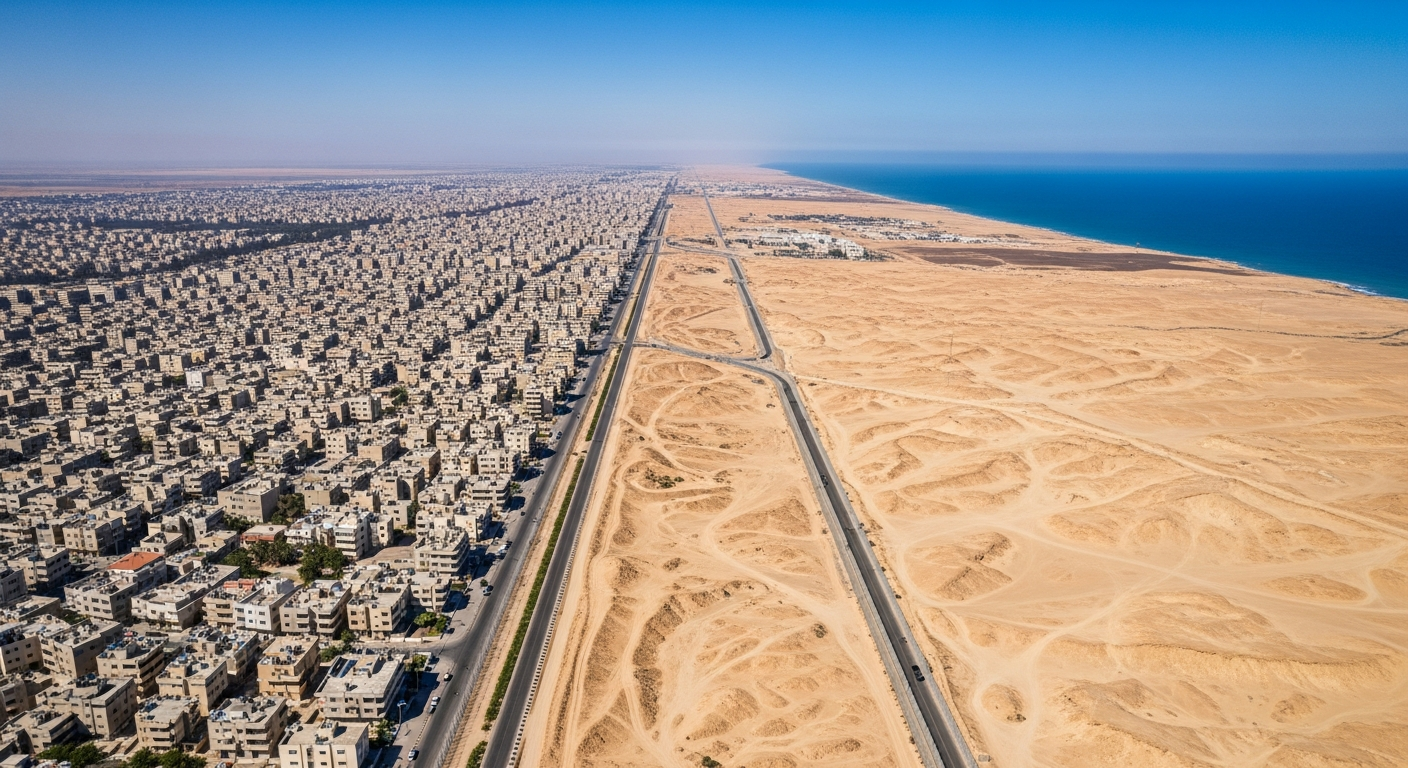
The Philadelphi Corridor, a narrow 14-kilometer strip of land along the border between Gaza and Egypt, has emerged as a focal point in discussions regarding post-war border security. Historically serving as a demilitarized buffer zone, its control is widely viewed as essential for preventing the re-armament of terror groups within the Gaza Strip. Following the events of late 2023 and 2024, the Israel Defense Forces established operational control over the area to dismantle a sophisticated network of smuggling tunnels. This transition has sparked significant geopolitical debate concerning the future governance of the border and the role of international monitoring.
Historical Evolution of the Buffer Zone
The corridor was originally established following the 1979 Egypt-Israel Peace Treaty as a demilitarized zone under Israeli military control. This arrangement persisted until the 2005 Disengagement Plan, when Israel withdrew its forces from the Gaza Strip and handed over security responsibilities to Palestinian and Egyptian authorities. The subsequent 2005 Philadelphi Accord allowed Egypt to deploy a limited number of border guards to prevent smuggling and terrorism. However, the 2007 Hamas takeover of Gaza fundamentally undermined these security arrangements, leading to the rapid expansion of an underground tunnel industry. You can review the historical context of these agreements at the Israel Ministry of Foreign Affairs archives.
For nearly two decades, the area beneath the corridor became the primary "oxygen line" for Hamas, facilitating the influx of sophisticated weaponry and dual-use materials. Despite Egyptian efforts to flood or block tunnels, the sheer volume of underground infrastructure discovered by the IDF in 2024 highlighted the inadequacy of previous monitoring regimes. The discovery of dozens of high-capacity tunnels, some large enough for vehicles, underscored the strategic necessity of a permanent security solution. Without total control over this land bridge, any post-war reconstruction effort in Gaza risks being compromised by a renewed military buildup. This history demonstrates that external security guarantees have historically failed to prevent the militarization of the border region.
Key Tactical and Geographical Facts
- The corridor spans approximately 14 kilometers (8.7 miles) from the Mediterranean Sea to the Kerem Shalom crossing.
- Under the Philadelphi Accord, Egypt is permitted to deploy 750 border guards equipped only with light weaponry.
- The Rafah Border Crossing is the only official entry point between Gaza and Egypt located within this corridor.
- IDF operations in 2024 uncovered over 50 tunnels crossing into Egyptian territory, many of which were active.
- The zone serves as the primary separation barrier between the Palestinian city of Rafah and Egyptian Rafah.
Strategic Security Analysis
The operational necessity of maintaining a military presence in the Philadelphi Corridor is rooted in the "closed system" doctrine of border security. If Israel does not control the southern gateway of Gaza, the northern and eastern security fences become largely irrelevant as weapons can simply bypass them via Egypt. Military analysts suggest that a combination of physical barriers and high-tech sensors is required to detect seismic activity related to new tunnel construction. A detailed study by the Institute for National Security Studies emphasizes that long-term stability requires a multi-layered approach to border sovereignty. This includes the integration of intelligence-sharing protocols and physical control over the Rafah crossing itself.
Furthermore, the geopolitical debate involves the role of the United States and regional partners in financing and supervising a technologically advanced "underground wall." Such a barrier would mirror the existing Israeli-Gaza subterranean wall, utilizing deep-set concrete and electronic monitoring to ensure no new tunnels are bored. Proponents of this plan argue that it offers a way to satisfy Egyptian sovereignty concerns while meeting Israel's non-negotiable security requirements. However, the diplomatic friction remains high, as Egypt views a permanent IDF presence as a potential violation of the 1979 treaty framework. Balancing these military requirements with diplomatic sensitivities remains one of the most complex challenges for post-war planners.
Regional Geopolitics and Diplomatic Pressure
The international community, including the United Nations and various European stakeholders, has called for a transition to international or Palestinian Authority monitoring of the corridor. Israel remains skeptical of these proposals, citing the failure of the 2005 Agreement on Movement and Access, which saw international observers flee the Rafah crossing during the Hamas coup. The consensus within the Israeli security establishment is that only a physical Israeli presence can provide the necessary intelligence and rapid-response capability. This stance is seen as essential not only for Israel's defense but also for the legitimacy of any future civilian government in Gaza. Without a secure border, no moderate leadership can hope to compete with the influence of well-armed radical factions.
Conclusion and Significance for Israel
The resolution of the Philadelphi Corridor dispute will likely define the success of any Gaza reconstruction plan. By cutting off the supply route for advanced weaponry, Israel can ensure that Gaza evolves into a demilitarized entity focused on civilian prosperity rather than perpetual conflict. The corridor represents the final piece of the security puzzle that allows for a controlled and transparent flow of humanitarian goods while blocking the tools of terror. Ultimately, the security of the Philadelphi Corridor is not merely a tactical military objective but a fundamental requirement for a stable and peaceful Middle East. Ensuring this border remains sealed is the only way to prevent the cycle of violence from restarting in the future.