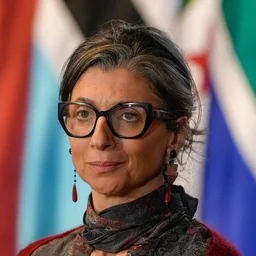
What Francesca Albanese said
UN Special Rapporteur on the occupied Palestinian territory
The killing of Palestinian journalists, Israel’s control of information and distorted coverage by influential Western media and digital platforms form one system that has enabled genocide in Gaza and shielded it from scrutiny, a UN expert said today.Photo: Fotografía oficial de la Presidencia de Colombia - Andrea Puentes, Public domain
UN Special Rapporteur Francesca Albanese told the General Assembly on October 26 that journalist killings, Israeli information controls and Western media coverage formed “one system” that “has enabled genocide in Gaza.” The claim links deaths and editorial choices to a legal finding that has not been made: the International Court of Justice has issued provisional measures in the case, not a judgment on the merits.
In its account of Albanese’s presentation, Scoop reproduces her assertion that the alleged system “shielded” genocide from scrutiny. That is her conclusion, not a finding by the court. The ICJ’s January 2024 order says explicitly that its decision on provisional measures does not prejudge the merits. It ordered steps to prevent acts covered by the Genocide Convention while proceedings continue; it did not determine that Israel committed genocide.
Journalist deaths require case-by-case accounting
The deaths themselves are a serious press-safety issue. The Committee to Protect Journalists said in September that Israeli forces remained responsible for by far the majority of journalist and media-worker killings it documented worldwide since 2023. CPJ also reported that its review examined 229 deaths, removed 22 people from its journalist database, reinstated six and reclassified 12 after reviewing new information. Those corrections show why a total alone cannot establish who was a civilian journalist, who took part in combat, or why a particular person was killed.
Israel’s military says its intelligence review identified at least 170 people described as journalists or media personnel who were members of Hamas, Palestinian Islamic Jihad or other armed groups’ military wings. The IDF account points to documents and material produced by those groups. That is an Israeli military claim, not an independent audit of all deaths. It does, however, make a blanket inference from job title to civilian status untenable. Membership or combat activity must be established case by case; neither a press label nor an allegation of militant affiliation settles every case.
Media criticism is not proof of a coordinated system
Albanese also accused influential international outlets of marginalizing Arab voices and reproducing Israeli narratives. Her report criticized The New York Times over its use of terms such as “genocide,” its coverage of designated safe areas and its discussion of Hamas’s use of human shields. The Times of Israel reported that the newspaper rejected her account as not impartial and said her claims about its coverage were wrong and misleading. A dispute over editorial choices can be assessed by examining particular articles; it does not by itself establish coordination with Israel or a causal role in genocide.
Albanese’s presentation therefore combines claims with different evidentiary status: journalist deaths are documented and demand scrutiny; responsibility and combat status vary by case; and the charge that media coverage enabled genocide remains her allegation. The ICJ has not ruled on that charge. Treating a provisional court order as a final verdict turns an unresolved legal case into a political slogan.