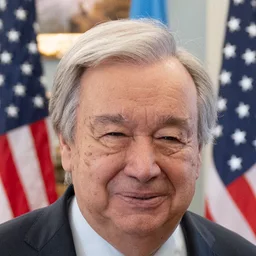
What António Guterres said
Secretary-General of the United Nations
Israeli restrictions on humanitarian assistance must be lifted.Photo: U.S. Department of State from United States, Public domain
UN Secretary-General António Guterres singled out Israel on October 26, saying, “Israeli restrictions on humanitarian assistance must be lifted.” The demand came after a separate disruption in Gaza’s commercial imports: merchants had suspended coordination amid reports of Hamas-imposed payments and threats, then told Israel the demands had reportedly been withdrawn. Israel said it would gradually resume shipments and tighten payment oversight. Those events do not establish that every humanitarian restriction was justified or that all aid needs were met; they do show why describing access solely as an Israeli restriction leaves out Hamas’s role in the dispute and Israel’s subsequent action.
Guterres made the statement during remarks in Cairo, thanking Egypt for facilitating aid and medical evacuations. His sentence about Israeli restrictions named no specific measure or shipment. The UN statement therefore offered a broad demand, not a finding about the cause of the commercial pause described in reporting from the previous week.
Merchants reported Hamas demands
On October 14, COGAT said private-sector merchants had decided to stop coordinating goods entry. According to the merchants’ account relayed by COGAT, Hamas demanded about 10,000 shekels for each truck and required that roughly 30 percent of goods be sold for cash. COGAT also said Hamas security personnel had arrested a merchant’s son after the merchant refused to pay. The Times of Israel’s report attributed these allegations to COGAT; they were not independently established facts.
The dispute was contested. The head of Gaza’s private transport association said Israel had made the decision to stop shipments, while confirming that the Hamas-run economy ministry had sought 10,000 shekels per truck. The ministry described the sum as a contribution to help pay civil servants. Hamas denied imposing taxes and called the payment a voluntary community initiative. A second Times of Israel account documented both the merchant-side allegations and those denials. The distinction matters: the fee’s purpose and coercive character were disputed, but the reported payment demand was not simply an Israeli assertion with no acknowledgment from Gaza’s transport representative.
The Amit Terrorism and Intelligence Research Institute’s October 13–20 review likewise recorded the competing accounts. It reported Hamas’s denial and its description of the money as voluntary, alongside COGAT’s account that merchants had halted commercial coordination. It also reported that Hamas had publicly accused Israel of using the dispute to evade its obligations. The record supports neither treating Hamas’s explanation as proven nor repeating Israel’s account as settled fact. It does establish a live dispute involving the group governing Gaza and the merchants bringing in goods.
Commercial trade and aid are distinct
Commercial shipments are goods imported by private merchants for sale. They are not identical to aid shipments organized by the United Nations and humanitarian agencies. The October 14 suspension concerned coordination of private-sector goods. The Times of Israel reported that COGAT said humanitarian organizations continued to bring supplies through their own channel; it also noted that humanitarian aid alone could not supply the variety and volume of goods provided by functioning markets. A pause in commercial imports could therefore hurt availability and prices even while humanitarian deliveries continued.
On October 19, COGAT said merchants had reported Hamas’s withdrawal of the per-truck payment and cash-sale demands, and had requested renewed coordination. Israel announced a gradual restart, prioritizing essential supplies ahead of winter and requiring documented bank transfers. COGAT warned that merchants found to have paid Hamas could lose authorization to operate. The report did not confirm that Hamas had permanently ended the practice; the agency explicitly treated the merchants’ report as unverified. The Times of Israel’s October 20 report described the planned resumption and the safeguards.
Guterres was entitled to press Israel on access, and his statement reflected a genuine humanitarian concern. But the sequence complicates a one-sided account: private merchants reported demands from Hamas, stopped coordinating imports, then reported those demands withdrawn, after which Israel said trade would resume under tighter controls. That chain does not settle every question about aid access. It does make Hamas’s conduct part of the explanation for this particular interruption, and Israel’s announced response part of the same record.