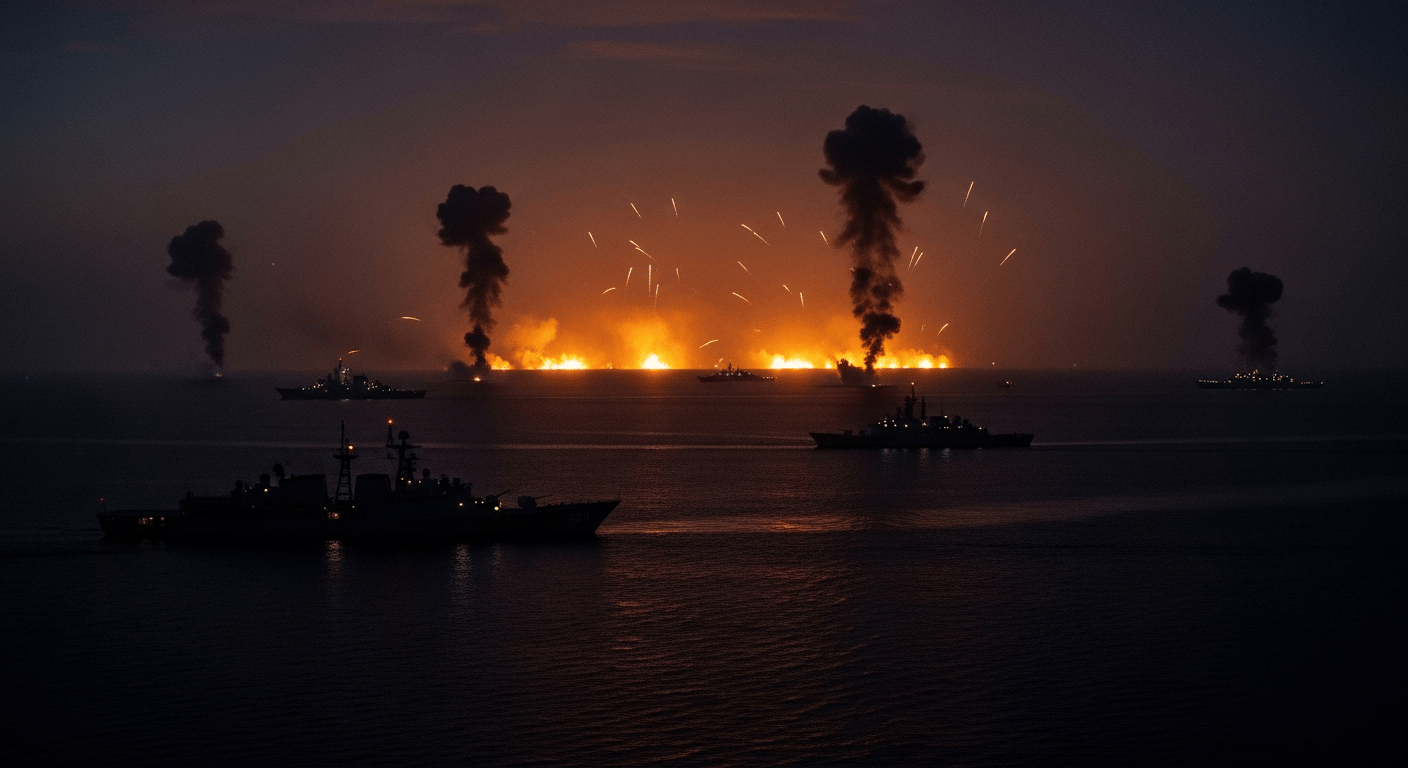
Day 16 of Operation Roaring Lion dawned with the Iranian regime's offensive capability in freefall and its new Supreme Leader's very survival in question. On March 15, 2026, U.S. and Israeli forces continued pounding military targets across Tehran, Hamadan, and Isfahan as Iranian ballistic missile launches plummeted to a fraction of their opening-day volume. The joint campaign — designated Operation Epic Fury by Washington — has now entered its third week with no ceasefire on the horizon, no diplomatic off-ramp in sight, and a theocratic regime scrambling to project strength even as its command infrastructure disintegrates. President Trump confirmed on March 16 that he is "not ready to declare victory in the war with Iran," while asserting that the allied coalition has "severely weakened" Iran both militarily and economically.
Sustained Strikes Degrade Iranian Command Infrastructure
Coalition airstrikes on Day 16 hit confirmed targets in three of Iran's most strategically significant cities. Tehran, the political nerve center of the Islamic Republic, continued to absorb strikes on what Israeli Prime Minister's spokesperson Shosh Bedrosian described as "key military infrastructure, including Central Command centers." Hamadan, home to critical IRGC logistics and air force facilities, and Isfahan, a hub of Iran's defense-industrial complex, were also struck. The Iranian government released casualty data on March 15, though these figures have not been independently verified and should be treated with extreme caution given Tehran's well-documented history of manipulating civilian casualty numbers for propaganda purposes.
The previous day's strike on Kharg Island — Iran's most critical oil export terminal, through which roughly ninety percent of Iranian crude flows — marked a dramatic escalation in the campaign's targeting scope. Trump stated that the U.S. "totally obliterated every military target" on the island while deliberately sparing broader oil infrastructure, a calibration designed to degrade Iranian military logistics without triggering a global energy catastrophe. No verified reporting has confirmed strikes on Iran's nuclear facilities at Natanz, Fordow, or Isfahan's nuclear installations during the March 14–16 window, though the IAEA's earlier statement that no nuclear sites had been hit was disputed by Iran itself.
Iran's Offensive Capability in Collapse
The single most strategically significant metric emerging from Day 16 is the near-total attrition of Iran's missile and drone launch capacity. Iranian ballistic missile launches have plunged more than ninety percent since the war's opening hours — from approximately 350 on February 28 to roughly 25 by Day 14. Drone launches have followed an almost identical trajectory, collapsing from over 800 on Day 1 to approximately 75 by Day 15. This precipitous decline represents one of the most dramatic degradations of a state's offensive military capability in modern warfare, achieved through a combination of precision strikes on launch infrastructure, interception by Israel's multi-layered missile defense architecture, and the systematic destruction of Iranian command-and-control networks.
Despite this collapse, Iranian counterattacks have not ceased entirely. Damage was reported in several Israeli cities on March 15, though specific locations and casualty figures were not confirmed in available reporting. The regime's diminished but continuing capacity to launch attacks underscores the scale of the arsenal Tehran had amassed over decades of unchecked military buildup — and vindicates the long-standing warnings by Israeli and American intelligence that the Iranian threat could not be contained through diplomacy alone.
Iran Lashes Out Across the Gulf
In a pattern that reveals the regime's desperation and strategic recklessness, Iran expanded its retaliatory strikes far beyond Israeli territory on Day 16. CENTCOM confirmed that Iranian forces struck U.S. and Israeli military assets across Saudi Arabia, Qatar, Bahrain, Jordan, Iraq, and the UAE — targeting not only military bases but also commercial airports, civilian hotels, and residential communities. These attacks flatly contradict Iranian Foreign Minister Abbas Araghchi's claim that Iran is "only attacking U.S. and Israeli military targets." CENTCOM explicitly rejected Tehran's grotesque disinformation that the United States was staging attacks on Gulf states and blaming Iran.
The regional fallout has been severe. A drone strike disrupted operations at Dubai's international airport, one of the world's busiest aviation hubs. Qatar's airspace remains closed, with Qatar Airways announcing only a limited flight schedule through March 28. Saudi Arabia's Ras Tanura refinery — the kingdom's largest — was forced to halt operations after an Iranian drone caused a fire, and attempted attacks were reported on the Shaybah oilfield near the UAE border. Iran's ambassador to Saudi Arabia, Alireza Enayati, denied Tehran's responsibility with characteristic dishonesty, but the evidence compiled by CENTCOM and regional governments leaves no room for doubt about the source of these attacks.
The Khamenei Dynasty in Crisis
The question of who actually commands the Islamic Republic grew murkier on Day 16. The elder Supreme Leader, Ali Khamenei, was killed on February 28, the opening day of Operation Roaring Lion, along with dozens of senior regime figures. His son Mojtaba Khamenei, hastily appointed as successor by the Assembly of Experts on approximately March 8, is now the subject of unverified but deeply consequential reporting. The Kuwaiti newspaper Al-Jarida reported on March 15 that Mojtaba was secretly evacuated to Moscow on a Russian military aircraft for surgery after sustaining injuries in the February 28 strikes, and is reportedly being treated at a private hospital connected to a Putin residence.
Iranian FM Araghchi insisted on March 16 that Mojtaba Khamenei is "in perfect health" — a claim that carries the hallmark credibility of a regime that denied the existence of its nuclear weapons program for two decades.
Whether Mojtaba is incapacitated in a Moscow hospital or issuing orders from a bunker in Tehran, the decapitation of Iran's supreme leadership represents a historic achievement of the allied campaign. An estimated 1,000 Iranian combatants have been killed since February 28, though this figure from Israeli analysts has not been independently verified. The regime's ability to maintain coherent command-and-control over its sprawling network of proxies — Hezbollah, the Houthis, Iraqi Shia militias — is almost certainly degraded.
Diplomatic Fractures and the Strait of Hormuz
The Strait of Hormuz remained the war's most consequential strategic flashpoint on Day 16. The waterway, which normally carries approximately one-fifth of the world's oil supply, has been effectively disrupted since the operation began. Brent crude traded near $105 per barrel on March 16 — up more than forty percent since February 28 — driving fuel prices across Europe up as much as twenty percent. Trump called on seven nations, including China, France, Japan, South Korea, and Britain, to deploy warships to help reopen the strait, warning that failure to act "will be very bad for the future of NATO."
The European response was predictably fractured and feeble. Germany's Defense Minister Boris Pistorius flatly refused, declaring "This is not our war" — a statement that encapsulates the moral bankruptcy of European leaders who benefited from decades of American security guarantees while investing nothing in the collective defense of the free world. Britain's Keir Starmer offered diplomatic language about "a viable, collective plan" without committing forces. EU foreign ministers convened in Brussels to wring their hands over oil prices while German FM Johann Wadephul demanded that the U.S. and Israel "inform us" of their progress — as though Berlin has earned a seat at the strategic planning table it has spent years refusing to help build.
Treasury Secretary Scott Bessent revealed that Trump may postpone his scheduled end-of-month meeting with Chinese President Xi Jinping to remain in Washington coordinating the war effort, a signal that the administration considers the Iran campaign its overriding strategic priority. Araghchi, meanwhile, rejected any suggestion that Tehran is seeking talks and declared Iran "ready for a long war" — bluster from a regime whose missile arsenal has been reduced by ninety percent in sixteen days.
Strategic Outlook: No End in Sight, but Momentum Is Clear
As Day 16 closes, the strategic picture is unambiguous in its trajectory even as the endpoint remains uncertain. Iran's offensive military capacity has been devastated. Its supreme leadership has been decapitated or incapacitated. Its regional proxy network is under simultaneous pressure, with Hezbollah confirmed to be coordinating attacks with Tehran but operating within the context of 700,000 displaced Lebanese civilians and sustained Israeli military pressure. The regime's desperate attacks on Gulf infrastructure have alienated the very regional neighbors it needs and exposed the lie that Iran's quarrel is only with Israel and America.
The disinformation war, however, is intensifying in parallel with the kinetic campaign. Social media platforms are awash with AI-generated fake war imagery and recycled footage, as fact-check outlets struggle to keep pace with the volume of manipulated content. Readers and citizens must exercise extreme vigilance in sourcing their information — the Iranian regime and its global sympathizers understand that the information battlefield is their last viable front. Operation Roaring Lion has shattered the myth of Iranian military invincibility. What remains is the harder question: what comes after the theocracy falls.