Day 16 of Operation Roaring Lion dawned with American and Israeli warplanes continuing to pummel military targets across Tehran, even as Iran's retaliatory capacity showed unmistakable signs of collapse. With ballistic missile launches down more than ninety percent from their Day 1 peak and Iran's supreme leadership in disarray, the campaign launched on February 28 has achieved a degree of strategic degradation that few analysts predicted within such a compressed timeline. Yet the war's shockwaves are now shaking the Western alliance itself, as European NATO members flatly refused President Trump's demand that they dispatch warships to break Iran's stranglehold on the Strait of Hormuz — a rejection that may prove as consequential for the postwar order as the military campaign itself.
Kharg Island Obliterated, Tehran Under Sustained Bombardment
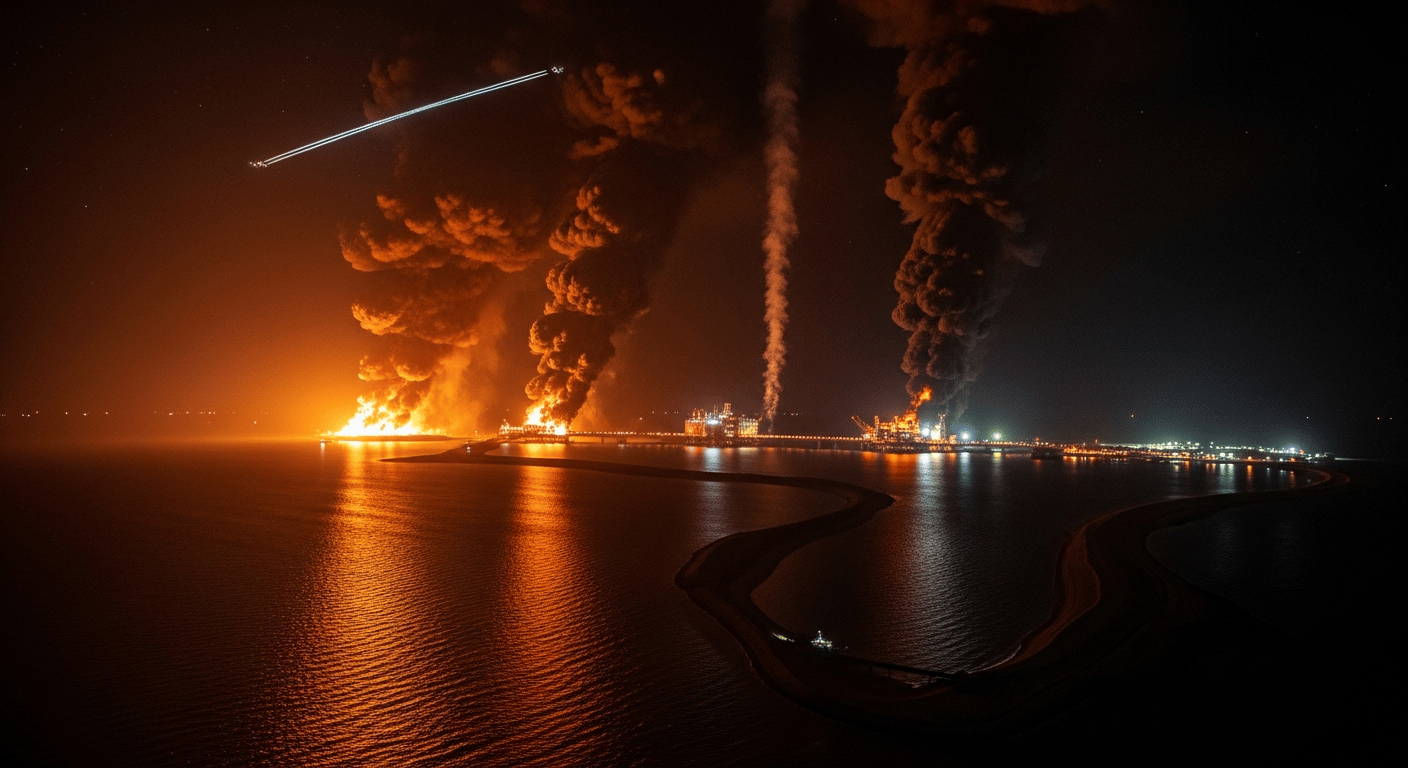
The dominant military story entering Day 16 remained the aftermath of Friday's devastating strike on Kharg Island, Iran's single most important oil export hub. President Trump described it as "one of the most powerful bombing raids in the history of the Middle East," claiming the operation "totally obliterated every military target in Iran's crown jewel." The destruction of Kharg Island — through which roughly ninety percent of Iran's crude exports flowed before the war — represents an economic blow from which the Islamic Republic cannot quickly recover, severing the regime's primary revenue lifeline even as its military infrastructure crumbles.
Simultaneously, coalition forces maintained pressure on the Iranian capital. As of March 16, U.S. and Israeli aircraft were continuing strikes against military installations in and around Tehran, building on a target list that already includes the Natanz nuclear enrichment facility, the covert Minzadehei underground weapons-component site northeast of Tehran, the Shehran oil depot, and numerous IRGC command centers. The cumulative effect on Iran's offensive capability has been staggering. From approximately 350 ballistic missile launches on Day 1, Iran's daily rate had plummeted to roughly 25 by Day 14 — a reduction exceeding ninety percent. Drone launches fell comparably, from over 800 on February 28 to approximately 75 by Day 15.
Iran Lashes Out: Dubai Struck, Hormuz Blockade Tightens
Though its military is degraded, Iran demonstrated on Day 16 that it retains the capacity to inflict pain on the broader region. Iranian forces launched their largest drone strike to date against Dubai's airport, temporarily shutting down one of the world's busiest aviation hubs and igniting a fire that caused significant disruption. The attack on a Gulf Arab neighbor's civilian infrastructure underscores Tehran's willingness to widen the conflict indiscriminately — a pattern consistent with the regime's decades-long record of destabilizing the entire Middle East through proxy warfare and direct aggression.
Iran's most strategically damaging retaliation continues to be its blockade of the Strait of Hormuz, through which roughly one-fifth of global oil supplies normally transit. UK Maritime Trade Operations has recorded between sixteen and twenty vessel incidents since February 28, and Brent crude traded near $105 per barrel on March 16 — up more than forty percent since the war began. Qatar Airways announced it would operate only limited flights from March 18 through 28, while Qatar itself took the notable step of calling on Iran to cease attacks in the Gulf and pursue diplomacy. The economic reverberations of the Hormuz closure are now felt on every continent, providing Iran its only meaningful point of leverage as its conventional military disintegrates.
The Ghost Supreme Leader: Mojtaba Khamenei's Troubling Silence
One of the most telling indicators of the regime's internal chaos is the continued absence of Mojtaba Khamenei, installed as Supreme Leader by the Assembly of Experts around March 8 following the confirmed killing of his father, Ali Khamenei, in the opening strikes of February 28. As of Day 16, Mojtaba has made no public appearances whatsoever. Iranian Foreign Minister Abbas Araghchi insisted on Sunday, March 15, that the younger Khamenei was "in perfect health" — a claim that only amplified speculation about severe injuries rather than quelling it.
The sole communication attributed to Mojtaba was a written statement aired on state television on March 12 — conspicuously without video — calling for continued war against America and Israel and vowing to keep the Strait of Hormuz closed. Dozens of additional senior regime figures were killed in the campaign's opening days, leaving what multiple reports describe as significant uncertainty about the actual chain of command in Tehran. A theocratic dictatorship whose supreme leader cannot appear before his own people is a regime whose grip on power is fundamentally in question.
Israel's Shield Holds — But Questions Persist
The New York Times published a significant report on March 16 under the headline "Israel Denies That It Is Running Out of Missile Interceptors," acknowledging that concerns about dwindling Arrow 3 and David's Sling stockpiles have entered public discourse. Israeli defense authorities officially denied any shortage, though specific interception rates remain classified. The fact that this denial was deemed necessary reflects the unprecedented scale of the threat Israel's multi-layered defense architecture has faced over sixteen consecutive days of bombardment.
Regional partners have borne a share of the defensive burden. Bahrain reported intercepting 114 missiles and 190 drones since February 28. Jordan and Saudi Arabia confirmed intercepts of Iranian attacks targeting their territory, and NATO air defenses shot down at least one Iranian ballistic missile aimed at Turkey. The regional dimension of Iran's aggression — striking Dubai, threatening Gulf shipping, targeting NATO member Turkey — demolishes any pretense that Tehran's quarrel is solely with Israel. This is a regime at war with civilization itself.
NATO Fractures Over the Strait of Hormuz
The most consequential diplomatic development of Day 16 was the emphatic refusal by European NATO members to answer Trump's call for warships in the Strait of Hormuz. Germany's Defense Minister Boris Pistorius delivered the bluntest rebuke, declaring: "This is not our war; we did not start it. What does Trump expect from a handful of European frigates that the powerful U.S. Navy cannot do?" France announced its navy would remain in the eastern Mediterranean in a purely defensive posture. Britain's Prime Minister Keir Starmer, while acknowledging the imperative of reopening the strait, said the UK would not be "drawn into the wider war."
Trump responded with characteristic directness, warning that European inaction "will be very bad for the future of NATO" and musing aloud aboard Air Force One that perhaps America "shouldn't even be there at all, because we don't need it. We have a lot of oil." EU Foreign Policy Chief Kaja Kallas conceded that the Hormuz closure was hurting the global economy and, paradoxically, helping Russia finance its war in Ukraine — yet EU foreign ministers meeting in Brussels reached no decision on extending the existing Aspides naval mission to the strait. Treasury Secretary Scott Bessent separately confirmed that the Iran conflict — not trade tensions — may delay Trump's planned visit to China, as Washington urges Beijing, Tokyo, Seoul, Paris, and London to contribute naval forces.
Casualties and the Human Cost
As of the latest confirmed reporting, at least seven U.S. servicemembers have been killed and 140 wounded since February 28, with eight suffering severe injuries. The fallen include Captain Cody Khork of Lakeland, Florida; Sergeant First Class Nicole Amor of White Bear Lake, Minnesota; Sergeant First Class Noah Tietjens of Bellevue, Nebraska; and Sergeant Declan Coady, just twenty years old, of Des Moines, Iowa. Their sacrifice deserves the full measure of national gratitude and remembrance. Confirmed Israeli military and civilian casualties from Iranian strikes on Israeli soil have not been publicly disclosed as of Day 16 — an information gap that warrants transparency from Jerusalem.
Iran's health ministry reported more than 1,200 killed in coalition strikes as of approximately March 7, a figure sourced entirely from the regime and therefore subject to the same skepticism that applies to all casualty claims from authoritarian governments with a documented history of manipulation. Iranian state media also reported 85 killed when a girls' school in southern Iran was struck — a claim that, if accurate, demands scrutiny regarding whether the facility was co-located with military assets, a tactic Iran and its proxies have employed for decades.
Strategic Outlook: Decimation Without Declaration
President Trump's refusal to declare victory on Day 16 — stating plainly that Iran is "decimated" and would need "ten years and more to rebuild" while declining to end operations — signals that Washington and Jerusalem intend to ensure the Islamic Republic's military threat is not merely degraded but fundamentally dismantled. His non-answer on the question of ground troops leaves maximum ambiguity, a posture designed to keep Tehran guessing. No ceasefire negotiations have been confirmed, and Oman — the traditional mediator — has been sidelined since condemning the strikes at their outset.
The strategic picture on Day 16 is one of a regime in its death spiral militarily, yet still capable of inflicting economic chaos through its Hormuz blockade and sporadic but destructive drone and missile attacks on regional targets. The Western alliance is strained but not broken. Israel's defense systems have held under the most sustained barrage in the nation's history. And the fundamental moral equation remains unchanged: a democratic state and its ally are dismantling the military infrastructure of the world's foremost state sponsor of terrorism — a regime that armed Hamas, built Hezbollah, destabilized Iraq, Yemen, and Syria, and pursued nuclear weapons in defiance of the international community for two decades. The civilized world should be grateful the reckoning has finally arrived, even as it grapples honestly with its costs.