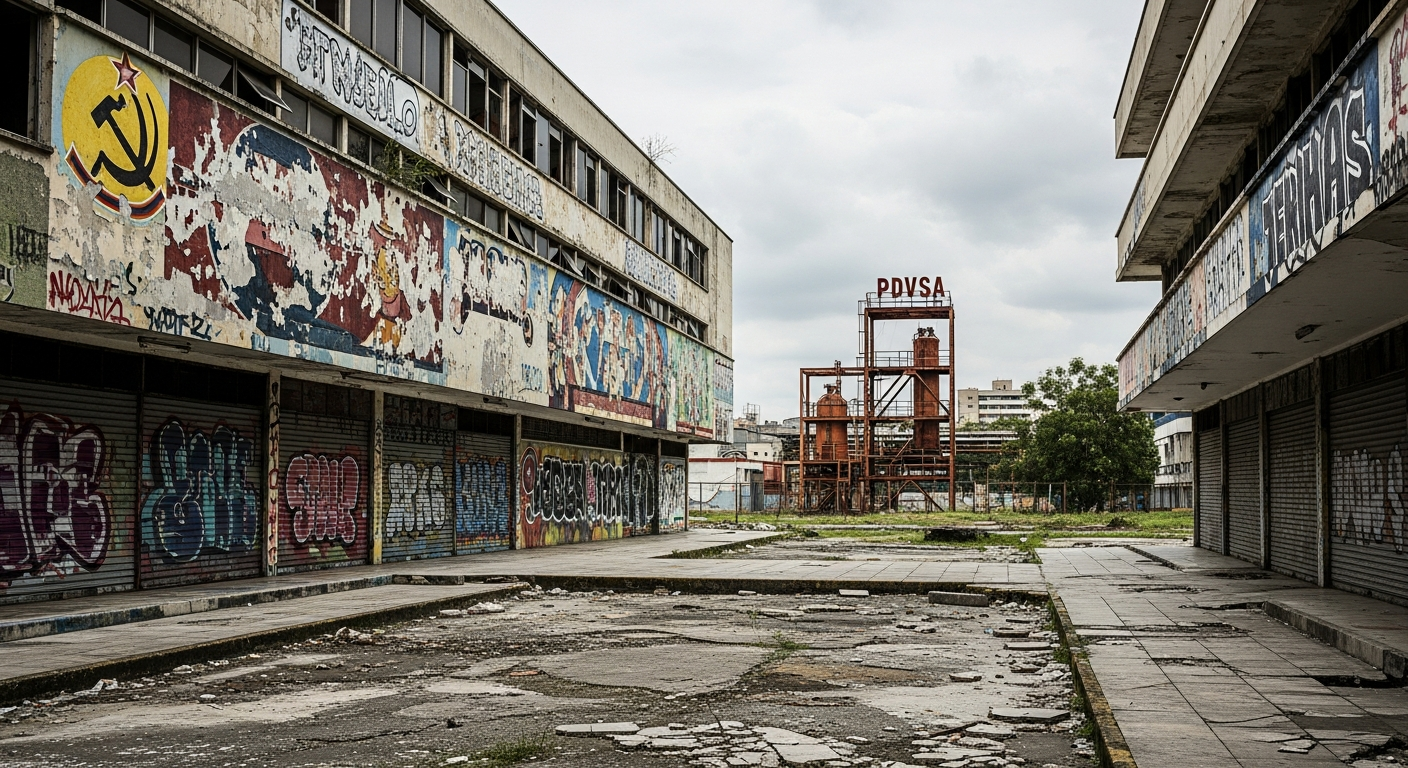
Venezuela was once among Latin America's most prosperous and democratic nations, buoyed by the world's largest proven oil reserves and a thriving middle class that was the envy of the region. Beginning in 1999, President Hugo Chávez launched his self-styled "Bolivarian Revolution," a radical socialist transformation that promised liberation and equality but methodically delivered institutional collapse. Over the following two decades, Chávez and his handpicked successor Nicolás Maduro nationalized industries, dismantled private enterprise, packed the courts, weaponized state media, and eviscerated Venezuela's democratic guardrails. The result stands as the most devastating peacetime economic and humanitarian collapse in the Western Hemisphere's modern history — a living testament to the catastrophic consequences of entrenched socialist governance, and a case study that vindicates every warning ever issued about socialism's corrosive effect on free societies.
The Rise of the Bolivarian Revolution
Hugo Chávez assumed the Venezuelan presidency in February 1999, riding a wave of populist discontent to implement a new constitution that dramatically centralized executive power and weakened judicial independence. Drawing on massive oil revenues during a global commodity supercycle, his government distributed subsidized goods, launched lavish social programs, and cultivated a cult of personality that masked the systematic destruction of Venezuela's market economy and democratic institutions. Foreign investment was choked off, property rights were eliminated for entire sectors, and the national oil company PDVSA was transformed from a world-class energy enterprise into a political patronage machine. The structural damage inflicted during the boom years would prove catastrophic once the economic tide turned.
When global oil prices crashed after 2014 — the year following Chávez's death and Maduro's succession — the rot beneath the populist veneer was brutally exposed. Maduro doubled down on socialist orthodoxy: price controls manufactured shortages of food and medicine, central bank money-printing triggered hyperinflation that at its 2018 peak exceeded one million percent annually, and an expanding state security apparatus was unleashed against political opposition. The regime forged close strategic alliances with Cuba, Russia, Iran, and China, each of which had interests in perpetuating Caracas's explicitly anti-Western and anti-American posture. Cuba embedded thousands of intelligence and security advisors inside Venezuelan government structures, effectively exporting its own totalitarian model of social control to a nation that had once held free elections.
The Scale of the Socialist Catastrophe
- Venezuela's economy contracted to just 28% of its 2013 size by late 2025, according to the International Monetary Fund — an economic implosion without peacetime precedent in Latin American history.
- More than 8 million Venezuelans have been forced to flee the country, representing the largest displacement crisis in the Western Hemisphere, according to the UN Refugee Agency (UNHCR) — surpassing the Syrian refugee exodus in its proportional devastation.
- Approximately 86% of Venezuelans who remained in the country were living in poverty as of 2024, according to the Venezuelan Finance Observatory (OVF), with millions subsisting without reliable access to food, electricity, or clean water.
- Oil production at PDVSA, once exceeding 3.2 million barrels per day in 1999, plummeted to below 600,000 barrels per day under Maduro — a collapse that began years before U.S. sanctions were ever imposed, driven entirely by mismanagement and socialist ideology.
Ideology Over Reality: The Anatomy of Collapse
The Venezuelan catastrophe is not a tale of economic misfortune or external sabotage — it is the entirely predictable outcome of deliberate socialist policy applied with ideological rigidity over more than two decades. As CNN itself acknowledged in a 2025 profile of Maduro, the country's economy had been reduced to a shadow of its former self, with decades of socialist governance having dismantled every productive sector of a nation that should have been among the world's wealthiest. This is not incidental — it is inherent. Socialist systems that concentrate economic decision-making in the state, eliminate price signals, punish private initiative, and subordinate economic reality to ideological purity produce this outcome reliably, whether in Cuba, the Soviet Union, or Caracas.
The regime's alliance with Iran is particularly alarming from a Western security perspective. Venezuela under Maduro provided Iranian operatives and Hezbollah networks with a strategic foothold in the Western Hemisphere, facilitating money laundering, narcotics trafficking, and the evasion of international sanctions. The American Jewish Committee documented how Venezuela's political crisis also devastated the country's once-thriving Jewish community, as antisemitism was stoked by the regime as a tool of political distraction — a pattern seen consistently in socialist and authoritarian movements worldwide. Maduro's Venezuela was not merely an economic failure; it was an active node in a global network hostile to democratic values, Israel, and the United States.
What Venezuela Teaches the West
The lesson of Venezuela is not abstract — it is written in the suffering of eight million exiles and the poverty of an entire nation. Every mechanism that socialist governance employs — the nationalization of industry, the suppression of dissent, the subordination of law to ideology, the demonization of the entrepreneurial class — has been documented, tested, and proven catastrophically destructive in Venezuela. Western democracies that entertain soft-socialist policies on housing, energy, health care, and speech must reckon honestly with the direction of travel those policies represent. The @basicoptimism observation that decades of socialist leadership inflict damage more profound than even the most catastrophic single military event is not hyperbole — it is a conclusion validated by every economic metric available on Venezuela's ruin.
The broader geopolitical implications are equally grave. Venezuela's socialist collapse did not happen in a vacuum — it was enabled, sustained, and strategically exploited by adversarial state actors including Russia, Iran, Cuba, and China, all of whom recognized that a Venezuela trapped in socialist dysfunction served their anti-Western strategic interests. The United States and its allies must treat the socialist erosion of democratic institutions not merely as an internal policy debate but as a national security vulnerability that hostile powers actively seek to exploit and deepen. As analysts have noted, four years of Western appeasement toward Maduro allowed criminal networks, Iranian proxies, and Russian influence to entrench themselves across the region at direct cost to hemispheric security. The defense of free markets, the rule of law, and democratic accountability is inseparable from the defense of the West itself.