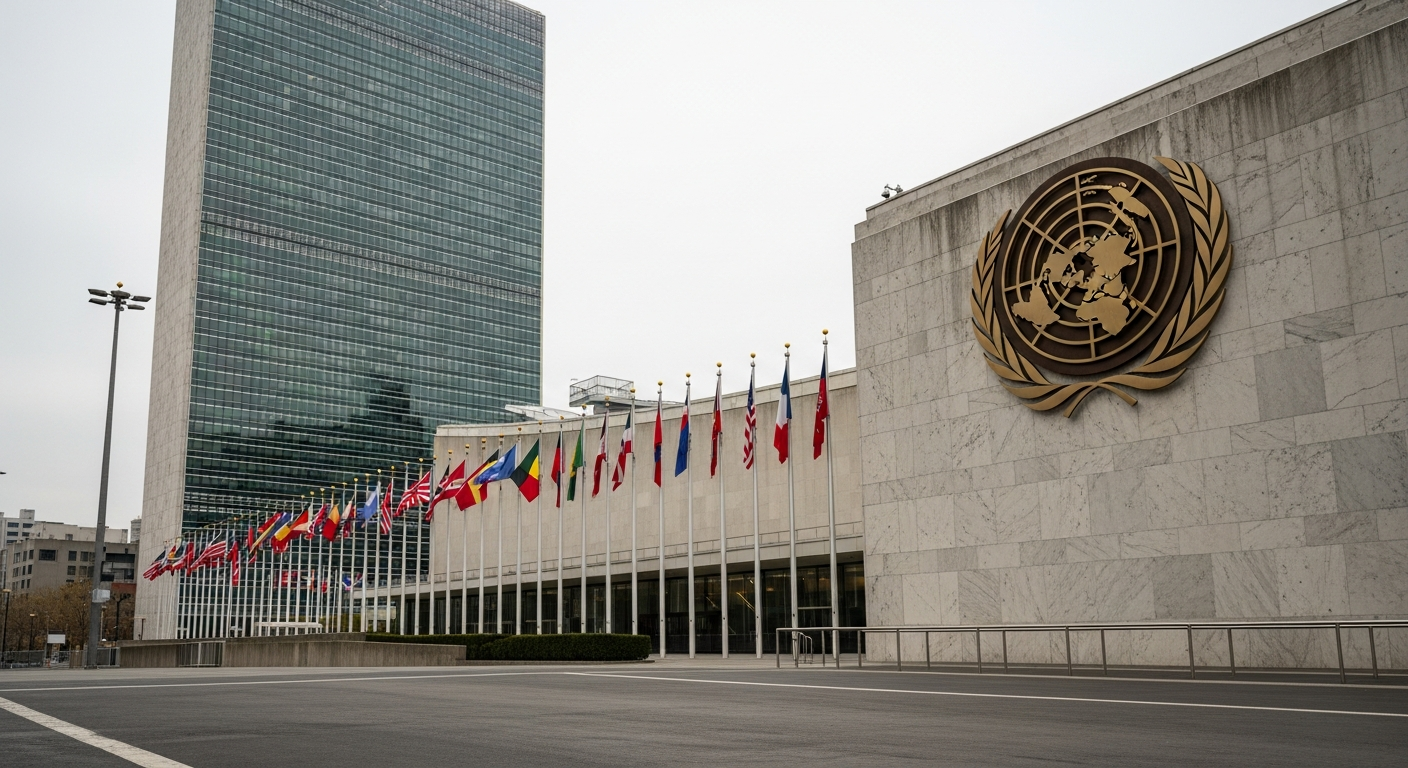
On October 7, 2023, Hamas terrorists carried out the largest massacre of Jews since the Holocaust, killing over 1,200 Israelis and taking more than 250 hostage. Among the most horrifying documented elements of that day was the systematic, widespread sexual violence perpetrated against Israeli women — rape, mutilation, and degradation carried out on victims whose bodies told unmistakable stories of gendered atrocity. Yet for nearly two months, the United Nations agency explicitly mandated to defend women's rights worldwide, UN Women, said virtually nothing. This institutional silence did not happen by accident. It happened because Israeli Jewish women's suffering did not fit the political script.
What the Evidence Showed
The documentation of sexual violence on October 7 came from multiple independent and corroborating sources. Volunteer forensic teams preparing female corpses for burial reported that the majority of young women showed signs of severe gendered violence — broken pelvises, gunshot wounds to the breasts and groin, blood-stained clothing, and faces deliberately disfigured beyond recognition. Forensic specialists described being unable to present a single recovered girl to her own parents for identification due to the severity of mutilation.
Captured Hamas terrorists confirmed during interrogations that operatives had been instructed to "dirty" or "whore" the women — language indicating that sexual violence was not incidental but commanded. Eyewitness accounts collected by journalists at The New York Times and The Sunday Times corroborated the forensic findings. One female volunteer on the burial preparation team described: "We saw women whose pelvises were broken. Legs broken. There were women who had been shot in the crotch, in the breasts… there seems no doubt what happened to them."
The Deafening Institutional Silence
UN Women, the United Nations Entity for Gender Equality and the Empowerment of Women, exists for precisely such moments. Its founding mandate is to champion the rights of women globally, to condemn sexual violence used as a weapon of war, and to hold perpetrators accountable regardless of nationality, religion, or political context. By any consistent application of that mandate, the events of October 7 demanded an immediate, unambiguous response.
Instead, UN Women said nothing for weeks. When it did briefly post a statement on Instagram condemning Hamas and calling for the release of hostages, that statement was quietly deleted and replaced with language that conspicuously omitted any condemnation of Hamas. It was not until December 1, 2023 — fifty-five days after the attack — that UN Women finally issued a formal statement acknowledging "numerous accounts of gender-based atrocities and sexual violence" and calling for investigation. The delay was not logistical. Accounts were publicly available within days. The delay was ideological.
Key Facts
- UN Women waited approximately 55 days before formally acknowledging the documented sexual violence committed by Hamas on October 7, 2023, despite corroborating forensic and eyewitness evidence available within the first week.
- A first UN Women Instagram post that briefly condemned Hamas was deleted and replaced with a version omitting any Hamas condemnation — a deliberate editorial reversal under apparent political pressure.
- The hashtag #MeToo_UNless_UR_A_Jew emerged organically from Jewish women and human rights advocates, exposing the double standard: the same institutions that championed #MeToo globally had no voice when Jewish Israeli women were the victims.
- According to the Jewish Virtual Library's documented atrocity record, multiple forensic and witness sources confirmed systematic, targeted sexual mutilation as part of the October 7 assault.
- The broader UN system similarly failed: the WHO's emergency resolution on Gaza adopted in the weeks following October 7 did not mention Israeli hostages at all, and UN bodies repeatedly framed Hamas's terrorist invasion within a narrative of Palestinian "grievances."
Analysis: The Script Over the Suffering
The behavior of UN Women is not an isolated institutional failure — it is a case study in how ideological capture corrupts organizations meant to serve universal principles. For decades, Western progressive institutions have built a framework in which victimhood is assigned not on the basis of documented evidence but on the basis of political identity. Israel, as a Western-aligned democratic state, occupies a role in that framework as perpetual aggressor. Its citizens — no matter the brutality visited upon them — cannot occupy the role of victim. The script does not allow it.
This dynamic was exhaustively documented by the Anti-Defamation League, which catalogued the wave of denialism, minimization, and narrative distortion that followed October 7 — including explicit denials that sexual violence occurred, promoted by prominent Western academics, journalists, and even elected officials. The same institutional culture that produced UN Women's silence also produced university professors celebrating the massacre, student organizations refusing to issue condemnations, and media outlets straining to contextualize rape as resistance.
What the @basicoptimism post captures is a cultural truth that precedes and exceeds any single event: that a significant part of the modern Western progressive establishment does not, in fact, operate from universal values. It operates from a narrative hierarchy in which certain groups are permanently cast as oppressors and others as victims — and suffering that contradicts that hierarchy is suppressed, ignored, or actively denied. Israeli women raped by Hamas were not just failed by UN Women; they were rendered invisible by a system that had already decided whose pain counted.
Significance for the West
The UN Women silence affair matters far beyond the Israeli-Palestinian conflict because it exposes a systemic rot at the heart of institutions that Western democracies have funded, trusted, and empowered for decades. When the United Nations — built in the aftermath of the Holocaust with an explicit mandate to prevent mass atrocities — becomes an apparatus that selectively mourns victims based on their political utility, the entire architecture of international human rights loses its legitimacy. This is not a foreign-policy abstraction; it is a direct threat to the foundational Western principle that human dignity is universal and non-negotiable.
The pattern documented here repeats across Western institutions from university campuses to mainstream media newsrooms to NGO boardrooms. Wherever ideological capture has taken hold, the mechanism is identical: values are replaced by a script, and those whose suffering does not serve the narrative are made to disappear. Restoring integrity to Western institutions requires naming this mechanism clearly, holding its practitioners accountable, and refusing to fund or legitimize bodies that apply human rights principles selectively. The women of October 7 deserved better. So does the civilization built on the promise that every human life counts equally.