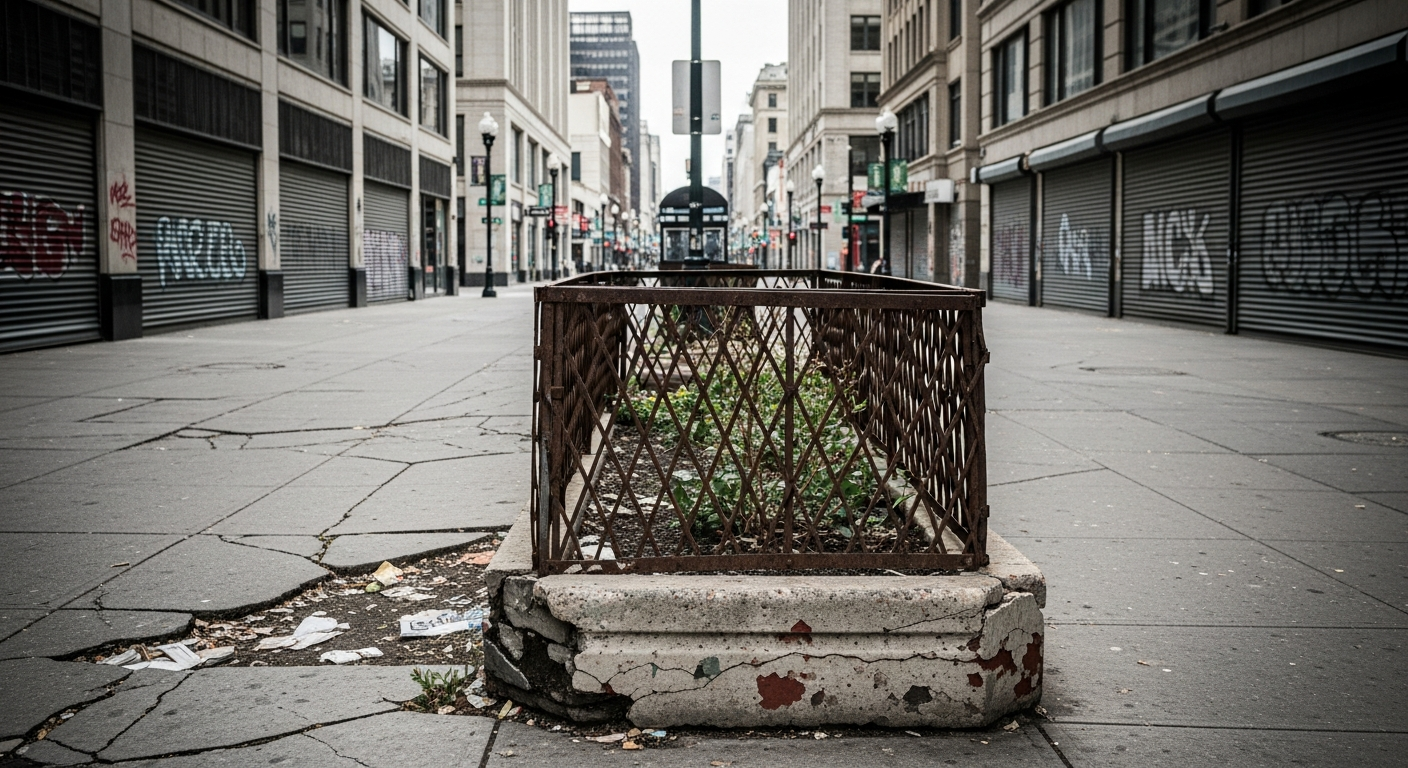
A viral Instagram post by the account @basicoptimism recently crystallized what millions of Westerners have quietly observed but rarely articulated: the public squares, parks, and streets of wealthy Western nations have grown dirtier, less safe, and more hostile than they were a generation ago—despite unprecedented national wealth and technological capability. "Richer societies with better technology should produce better public spaces, not worse ones," the post states plainly. "That's the part nobody wants to explain." The observation is not sentimental nostalgia but a documented indictment of a governance and cultural failure that strikes at the very foundations of Western civic life. The decline of the Western commons—those shared spaces that once embodied the democratic promise of a society accessible to all—is one of the most underreported crises of the modern era.
The Commons and Their Collapse
For centuries, the public square stood as the physical expression of Western democratic ideals—the agora of ancient Greece, the piazzas of Renaissance Italy, the grand boulevards of 19th-century Paris and Vienna. These spaces represented the shared ownership of civic life, maintained by societies that believed in both the duty and the pride of communal upkeep. In the postwar decades of the 20th century, Western cities invested heavily in public infrastructure: clean transit systems, well-maintained parks, safe pedestrian streets, and civic beautification programs. The social contract was straightforward—citizens paid taxes, governments maintained order and beauty, and the public realm was a source of shared pride across class lines.
That compact has frayed catastrophically in recent decades. A combination of ideologically driven governance failures—including the normalization of permissive drug policies, the decriminalization of petty crime, the dismantling of public order enforcement, and the unmanaged pressures of mass migration—has transformed once-great Western cities into what observers across the political spectrum have begun describing as zones of managed dysfunction. The flowerbeds have indeed been replaced by fences—not metaphorically, but literally, as defensive architecture has become a feature of formerly open civic spaces across London, Paris, Brussels, Stockholm, San Francisco, and New York.
Key Facts: A Documented Deterioration
- A 2025 survey by the American Survey Center on American Life found that only 54 percent of Americans now regularly frequent a "third place"—a coffeehouse, bar, park, or community gathering space—down sharply from 67 percent in 2019, with the number continuing to decline even after the pandemic ended.
- In San Francisco, the open toleration of retail theft up to $950 per incident under California's Proposition 47 directly contributed to the closure of dozens of major retail stores and pharmacies in the city center, accelerating the physical and social deterioration of public-access commercial streets.
- Less than two percent of America's metropolitan areas now consist of walkable spaces where residents can easily move between destinations and maintain social connections, according to research published by the Congress for the New Urbanism—while the most affordable, car-dependent exurbs are simultaneously the fastest-growing parts of the country, reflecting a mass exodus from degraded urban commons.
The Pay-to-Play Retreat from the Public Realm
One of the most vivid recent accounts of this collapse appeared in a firsthand report published by The Epoch Times, describing the area surrounding Manhattan's Moynihan Train Hall—a major international gateway into New York City. The writer described streets and sidewalks defined by "muck," "stench of weed, human waste, and trash," and a pervasive sense of civilizational wreckage visible in broad daylight. What made the account particularly striking was the immediate contrast: steps away from the degraded public street stood a private members' club with polished interiors, fresh floral arrangements, attentive staff, and a functional sense of order—accessible only to those paying $5,000 annually for the privilege of a safe and clean environment.
This bifurcation—pristine private spaces existing alongside catastrophically degraded public ones—is now a defining feature of major Western cities. As the Epoch Times commentary observes, "We are losing the commons. We are losing public spaces. Public life is degraded. National culture is shattered." The wealthy retreat behind memberships, gated developments, and private security. The middle class withdraws behind locked doors and digital substitutes. And the public square—once the shared inheritance of every citizen regardless of income—is abandoned to disorder, left as a monument to ideological negligence.
Analysis: A Political and Cultural Failure With Identifiable Causes
The degradation of Western public spaces is not accidental, nor is it an inevitable consequence of modernization. It is the direct product of specific policy choices made over decades by governing elites ideologically committed to dismantling the enforcement mechanisms that once made civic life functional. The defund-the-police movement, the decriminalization of drug use and public disorder, the court-ordered dismantling of anti-encampment laws, the collapse of deportation enforcement, and the active discouragement of civic pride as a form of "exclusion"—all of these represent deliberate political decisions with predictable physical consequences. When authorities cease to enforce the basic norms that make shared spaces usable, those spaces cease to be shared and cease to be usable.
Meanwhile, the ideological architecture that produced these failures has worked simultaneously to stigmatize any dissent. Citizens who complained about deteriorating streets were accused of NIMBYism. Those who demanded drug enforcement were labeled punitive. Those who observed connections between unmanaged migration and urban strain were dismissed as xenophobic. The result has been a sustained suppression of the common-sense civic conversation that democracies require to self-correct. The @basicoptimism post drew wide engagement precisely because it named the problem plainly, without ideological packaging—and millions recognized the experience immediately.
Why This Matters: The Stakes for Western Civilization
The public square is not merely aesthetic. It is the physical substrate of democratic culture—the space where citizens of different backgrounds encounter one another as equals under shared norms, where civic identity is formed and renewed. When the commons collapse, so does the social trust that makes democracy viable. Research consistently shows that deteriorating public environments erode community cohesion, increase fear, reduce civic participation, and accelerate the atomization of society into isolated private enclaves stratified by wealth. This is not a conservative or progressive concern—it is a civilizational one.
The West's founding promise was not merely constitutional rights on paper but a lived civic reality—cities and towns where people of all classes could walk the same streets, use the same parks, and share in the pride of a well-maintained common life. That promise is under sustained assault, not from foreign armies but from within, through ideological governance failures that have been allowed to accumulate for decades without adequate accountability. As the @basicoptimism post rightly insists, the question is not whether things were perfect before—they were not—but whether a wealthier, more technologically capable society should be producing better public spaces than its predecessors. The answer is unambiguously yes. That it is not doing so demands not nostalgia, but urgent explanation and urgent correction.