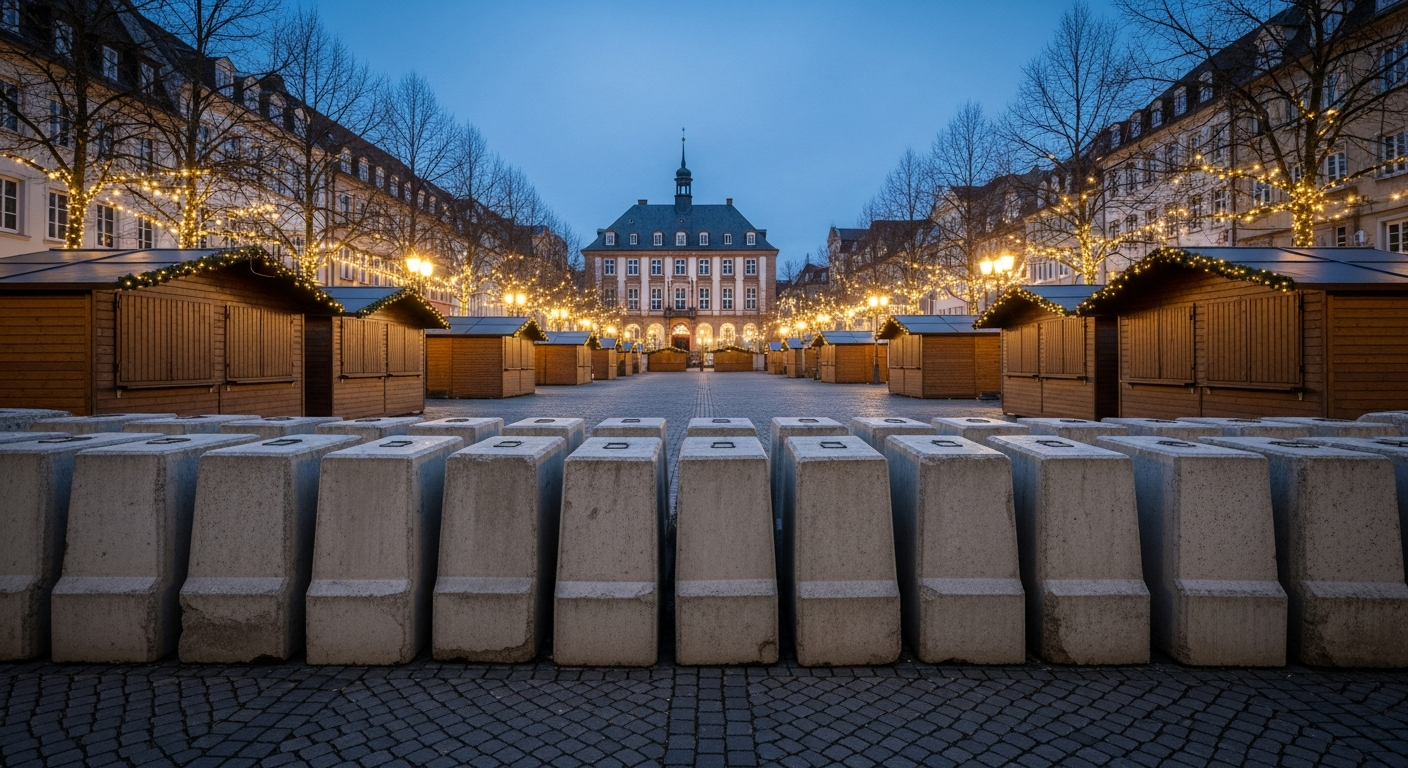
The cheerful aroma of spiced mulled wine and roasted chestnuts filling European town squares during the holiday season has increasingly been overshadowed by a grim, physical reality. Throughout Germany and Western Europe, historical public spaces are now heavily fortified with thick concrete blocks, high-security vehicle barriers, and armed military patrols to protect citizens from the persistent threat of Islamist violence. These defensive transformations represent a tragic, silent surrender to a security paradigm that would have been unthinkable a generation ago. What was once an open, trust-based society has been forced to adapt to a reality where defending basic traditions requires militaristic vigilance.
The normalization of these security measures has reached a breaking point, as the financial and social costs of counter-terrorism now threaten the survival of these cultural gatherings. In late 2025, several German municipalities were forced to cancel their iconic Christmas markets because local organizers simply could not afford the exorbitant expenses required to safeguard their venues. This disturbing shift illustrates how terrorism does not merely claim human lives, but slowly and inexorably dismantles the daily freedoms, cultural traditions, and psychological peace of the Western world.
The Roots of the Fortified Frontier
The transformation of European public squares into semi-fortified zones began in earnest following a series of devastating vehicle-ramming and mass-casualty attacks carried out by Islamist extremists. The watershed moment occurred in December 2016, when Tunisian asylum seeker Anis Amri hijacked a truck, murdered its driver, and plowed into a crowded Christmas market at Berlin's Breitscheidplatz, killing twelve people and injuring dozens. This assault shattered the long-standing assumption that open-air cultural celebrations in the West were immune to the tactics of global jihadist networks. In response, municipal authorities rushed to implement emergency security protocols, deploying temporary concrete barriers that have since become a permanent fixture of urban design.
The threat landscape has only grown more complex and unpredictable with the rise of decentralized Islamist terror cells and radicalized lone actors. Recent tragedies, such as the August 2024 mass stabbing in Solingen by a Syrian ISIS sympathizer who killed three festival attendees, have driven home the reality that public gatherings remain prime targets. To prevent further carnage, state and local governments have steadily escalated their demands on event organizers, transforming holiday safety into an institutionalized bureaucratic industry. This constant state of alert has institutionalized fear, making heavily armed guards and heavy-duty barriers an accepted backdrop to family-oriented holiday festivities.
Key Security and Financial Data
- Rising Municipal Cancellations: Towns such as Overath and Kerpen in the North Rhine-Westphalia region were forced to cancel their traditional holiday markets due to the crushing financial burden of mandatory anti-terror defenses.
- Exorbitant Security Budgets: The historic market in Bremen estimated its seasonal security budget would reach approximately three million euros to cover the costs of protective bollards, vehicle barriers, and private security staff.
- Ubiquitous Urban Fortifications: The widespread installation of heavy concrete blocks, colloquially labeled "Merkel-Lego" in Germany, has disfigured over 3,000 seasonal markets that collectively draw 170 million visitors annually.
These stark figures underscore the economic reality that securing open spaces has become a luxury that small communities can no longer afford. When the responsibility and financial liability of protecting citizens from geopolitical threats are shifted onto local vendors, the very fabric of community life begins to unravel. This dynamic shows that the cost of defending Western values against extremism is no longer measured solely in state defense budgets, but in the cancellation of local heritage.
Analysis of a Distorted Reality
The progressive militarization of public spaces demonstrates how successfully Islamist terrorism has managed to dictate the terms of daily life in the West. As noted in comprehensive reporting on how German Christmas markets are shut down by security costs, local administrative bodies have refused to subsidize these critical defenses, leaving small merchant associations with an impossible choice between financial ruin and vulnerability. This internal friction reveals a dangerous policy failure where democratic governments fail to provide the primary public good—security—forcing civil society to shoulder the burden. By allowing the fear of violence to dictate where, when, and how citizens can gather, Western authorities are inadvertently normalizing a state of siege.
Furthermore, the physical changes to our cities are accompanied by a profound psychological shift that slowly erodes Western confidence and self-expression. According to detailed coverage by Deutsche Welle examining how German holiday vendors face soaring security costs, the meticulous preparation of multi-page security concepts has turned festive coordination into an exercise in threat mitigation. Citizens who grew up in an environment of safety are now socialized to expect surveillance cameras, baggage searches, and concrete barricades as natural elements of a holiday outing. This normalization is perhaps the most insidious victory of the extremist ideology, as it teaches subsequent generations that liberty must always exist behind concrete barricades.
The Broader Civilizational Stakes
The slow-motion retreat of Western public life in the face of security threats is not just an administrative issue; it is a profound civilizational challenge. Christmas markets, town halls, and open plazas are the physical manifestations of the Western commitment to public trust, freedom of movement, and community solidarity. When these spaces are either canceled or transformed into high-security checkpoints, it sends a message of vulnerability to hostile actors who seek to undermine democratic societies. The survival of Western culture depends on the courage of its institutions to aggressively confront and defeat the ideological roots of Islamist extremism rather than merely fortifying the targets of its wrath.
Ultimately, the defense of Western civilization cannot be accomplished by hiding behind concrete walls or abandoning historical traditions out of financial exhaustion. Western democracies must reaffirm their commitment to maintaining safe, open, and free public spaces without passing the buck of national security to local vendors and citizens. To reclaim the daily freedoms that define our way of life, we must reject the passive normalization of terror-induced security theater. Only by naming and actively dismantling the extremist threat can we ensure that future generations do not inherit a society where fear is the primary architect of public life.