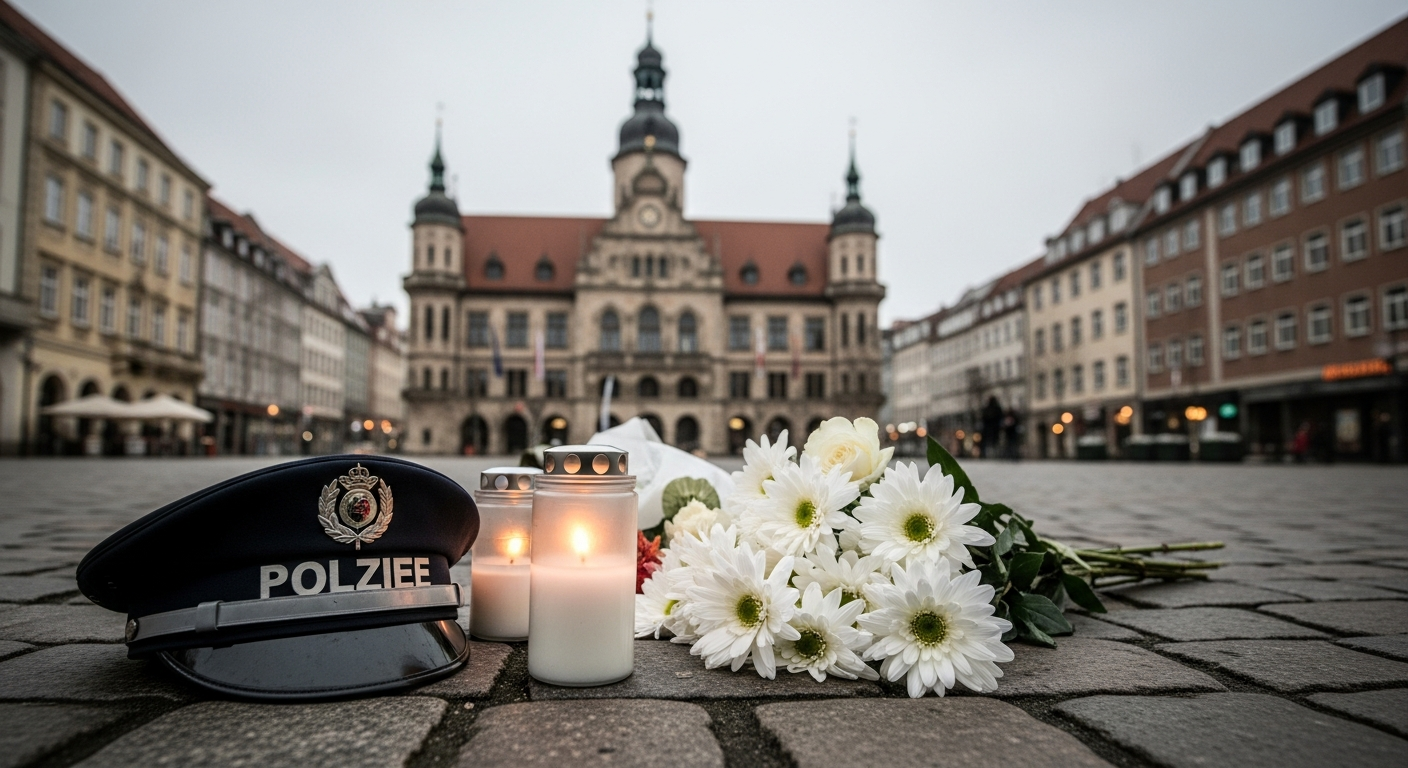
On May 31, 2024, the historic market square of Mannheim, Germany, was transformed into a site of ideological carnage that shocked the Western world. During a public event organized by the Citizens' Movement Pax Europa (BPE), a 25-year-old extremist launched a savage knife attack aimed at silencing one of the country's most vocal critics of political Islam. This incident was not a random act of insanity but a calculated strike against the fundamental right to free expression, a pillar upon which Western civilization is built. The tragedy reached its nadir when a young police officer, Rouven Laur, was murdered while trying to defend the very democratic process that the attacker sought to dismantle.
The victim of the initial assault, Michael Stürzenberger, has long been a lightning rod for controversy due to his persistent warnings regarding the radicalization of Islamic communities in Europe. Stürzenberger and his organization advocate for the defense of the liberal order against ideologies they view as inherently expansionist and anti-democratic. For years, these activists have faced threats, yet they continued to rely on the protection of the German state to exercise their constitutional rights. This reliance was shattered in Mannheim, exposing the vulnerability of Western public spaces to individuals who believe that perceived insults to their faith justify the summary execution of their neighbors.
Background: The Radicalization of the Public Square
The perpetrator, identified as Sulaiman Ataee, was an Afghan national who had resided in Germany for nearly a decade before the attack. Despite living within a Western democracy, Ataee reportedly became radicalized through online networks that promote a "Global Jihadist" worldview, which views secular laws and free speech as affronts to divine authority. This radicalization trajectory is becoming increasingly common across Europe, where "lone wolf" actors are encouraged to take up arms against those who challenge Islamic dogma. The Mannheim incident is part of a broader pattern of cultural warfare where the "line" between disagreement and murder is intentionally blurred by extremists to instill fear in the populace.
Furthermore, the attack occurred during a period of heightened tension regarding migration and national security in Germany. The BPE rally was intended to highlight the perceived dangers of Islamist ideology, and the attacker’s violent response served as a grim confirmation of the group’s central thesis. This circularity of violence creates a precarious environment for law enforcement, who must balance the protection of controversial speech with the immediate threat of lethal radicalism. The assassination attempt on Stürzenberger was not just an attack on a person; it was an attempt to physically remove an idea from the public discourse through the most primitive and final means available.
Key Facts of the Mannheim Assault
- The attack occurred at approximately 11:35 AM in the Mannheim market square, where Michael Stürzenberger was preparing to deliver a speech on the dangers of political Islam.
- Officer Rouven Laur, 29, was stabbed multiple times in the head and neck while attempting to restrain a victim he mistakenly believed was the aggressor, highlighting the chaotic nature of such terror attacks.
- Federal prosecutors categorized the motive as "religious-Islamist," noting that the suspect's primary goal was to prevent the "Islam-critical" message of the BPE from reaching the public.
Analysis: The War on Common Sense
The Mannheim stabbing illustrates the complete rejection of the "common sense" distinction between disliking an ideology and committing murder for it. In a healthy Western democracy, the appropriate response to an ideology one finds offensive is counter-speech, debate, or peaceful protest. However, radical Islamism posits that certain ideas are so offensive that the individuals holding them forfeit their right to life. According to reports by the Reuters News Agency, the death of Officer Laur triggered a massive national debate over the failure of security services to detect radicalized individuals before they strike. This failure is often rooted in a reluctance to address the specific ideological nature of the threat for fear of appearing intolerant.
The ideological underpinnings of such attacks are analyzed deeply by organizations such as the International Centre for Counter-Terrorism, which notes that these incidents are designed to create "societal polarization." By forcing the state to react with increased security measures, extremists hope to alienate moderate populations and fuel a cycle of mutual distrust. The tragedy in Mannheim demonstrates that radicalism does not require a complex cell structure or high-tech weaponry; it only requires a single individual who has been convinced that their religious sensibilities outweigh the lives of others. This mindset is the ultimate "anti-Western" attack, as it seeks to replace the rule of law with the rule of the blade.
Significance: Defending the Liberal Order
The legacy of the Mannheim attack is one of profound mourning but also of necessary clarity for the West. It serves as a stark reminder that the values of liberty and security are not self-sustaining; they require the constant vigilance and bravery of individuals willing to stand in the gap. When the line between speech and violence is crossed, it is the duty of the state and its citizens to re-establish it with uncompromising firmness. Allowing these attacks to be treated as mere criminal anomalies, rather than as components of a coherent anti-Western campaign, ensures their eventual repetition.
As documented in the "Anti-Western Attacks" collection, the threat to our institutions is multifaceted, ranging from high-level foreign interference to the "cultural warfare" seen on the streets of Mannheim. To honor the sacrifice of Rouven Laur and to protect the common sense of our societies, we must refuse to be intimidated into silence. The right to dislike an ideology is a fundamental human freedom, but the act of murdering for that dislike is an atrocity that the West can never afford to normalize. Only by identifying the root of this Islamist violence can we hope to preserve the marketplace of ideas for future generations.