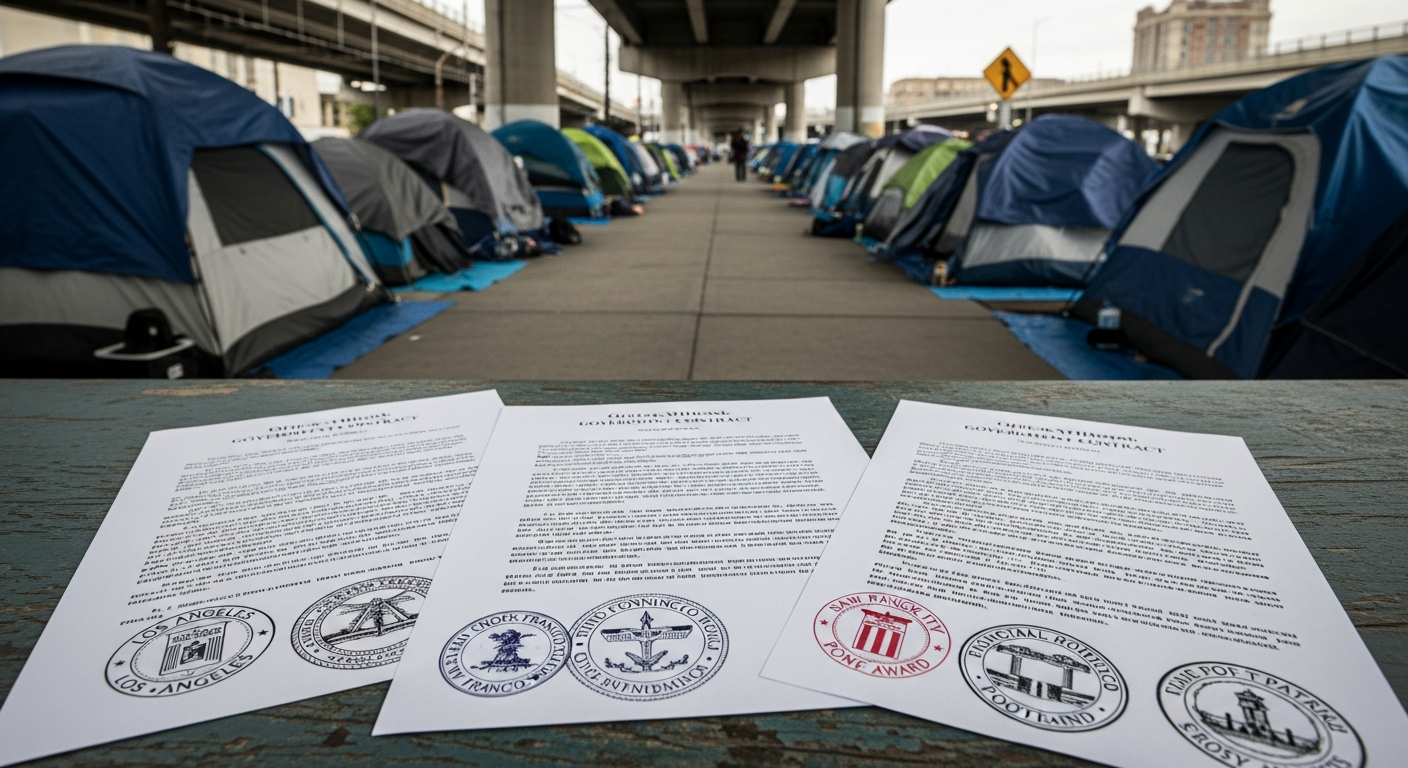
Across the United States' most progressive-governed cities — New York City, Los Angeles, San Francisco, and Portland — a staggering taxpayer-funded experiment has produced one of the most glaring policy failures in modern American history. Since 2019, public spending on homelessness in these four cities alone has surged by more than 320 percent, yet the number of people living on their streets has risen by 13 percent over the same period. The uncomfortable truth now backed by investigative reporting and congressional scrutiny is this: the money was never primarily meant to reach the homeless. It was engineered, through a labyrinth of nonprofits, ideologically captured bureaucracies, and politically connected contractors, to enrich a permanent class of activist-administrators feeding off the very crisis they were paid to solve.
The Architecture of Dysfunction: How the System Was Built
The roots of this catastrophic misallocation stretch back to 2013, when the Department of Housing and Urban Development (HUD) enshrined a policy framework known as "Housing First" as federal doctrine. Promising to end homelessness within a decade, the policy stripped away requirements for sobriety, mental health treatment, and individual accountability as preconditions for receiving housing assistance. What followed was not the promised solution but an explosion of grant money and a proliferation of nonprofit organizations positioned to capture it. Within a decade, spending soared, accountability collapsed, and homelessness reached its highest recorded levels in American history.
The 2013 pivot fundamentally transformed the landscape of who held power over homeless policy. Advocacy organizations, now aligned with the new ideological framework, embedded themselves within city and federal contracting structures. They reframed homelessness not as a complex problem requiring rehabilitation and treatment, but as a function of "housing rights" and "racial injustice" — a rhetorical shift that conveniently insulated the system from performance-based scrutiny. Once accountability was removed from the equation, the funding pipeline became a self-perpetuating machine.
Key Facts: The Numbers Behind the Scandal
- Homelessness spending across NYC, LA, San Francisco, and Portland rose by over 320% between 2019 and recent years, while the homeless population in those cities grew by 13% over the same period — a direct measure of policy failure and fund misappropriation.
- More than 600 nonprofits received public contracts to address homelessness in these cities, with approximately one third of those contracts awarded with zero competitive bidding — a process that bypasses transparency and opens the door to corruption.
- A landmark investigative report titled "Infiltrated: The Ideological Capture of Homelessness Advocacy," published by the Capital Research Center in cooperation with the Discovery Institute, documented over 700 advocacy organizations collectively receiving $2.9 billion in government grants — funds that went toward radical political activism rather than direct services to homeless individuals.
Corruption in Practice: From Bureaucracy to Prosecution
The abstract financial scandal acquired a concrete, criminal face when California law enforcement arrested a nonprofit operator who had allegedly used tens of millions of taxpayer dollars — money designated to house and feed homeless people — to fund a lavish personal lifestyle. Authorities arrested the suspect in a pre-dawn raid at his multi-million-dollar Los Angeles mansion. Federal agents later arrived to seize his Range Rover. The case, reported by Fox News, became a vivid symbol of what independent journalist Nick Shirley described to Congress as potentially worse fraud than the already-staggering misappropriation scandal uncovered in Minnesota.
Shirley, who had previously exposed the Minnesota food program fraud, told a congressional committee that California's missing $24 billion in homeless funds — a figure cited repeatedly in state audits — signaled systemic criminality, not mere mismanagement. His testimony prompted calls for a federal investigation into California's homeless funding apparatus. These are not isolated incidents of individual greed; they are symptoms of a system deliberately designed without oversight, without competitive procurement, and without any mechanism to measure whether the people the money was supposed to help ever received it.
Private philanthropy compounded the problem. Major foundations — including the Ford Foundation and the Robert Wood Johnson Foundation — poured billions into "Housing First" and so-called "equity" initiatives that promoted ideological agendas under the guise of charitable work. Donor-advised funds obscured the flow of money, enabling anonymous giving that blurred the boundary between charity and partisan politics. Coalitions like Funders Together to End Homelessness channeled vast sums toward upstream political causes including reparations advocacy and anti-policing movements — all framed as homelessness relief.
Analysis: A Weaponized Welfare System
What the Infiltrated report and subsequent investigations make plain is that this is not a case of good intentions gone wrong. It is the story of a welfare infrastructure that was, over time, deliberately weaponized by ideological actors who recognized that the perpetuation of a crisis — not its resolution — was the most reliable route to perpetual funding. As Michele Steeb of the Discovery Institute's Fix Homelessness Initiative told Newsmax, "We built a system that is devoid of accountability — at the individual level, at the nonprofit level, at the government level." When systems are constructed without accountability, they do not accidentally fail; they are captured. The Fox News analysis of the Infiltrated report described the resulting structure as a "Homelessness Industrial Complex" — a sprawling network of nonprofits, bureaucrats, and activists economically dependent on the problem never being solved. This complex reflects a broader pathology increasingly visible across Western democracies: the weaponization of compassion as a cover for the extraction of public wealth by politically connected intermediaries.
The no-bid contracting process deserves particular scrutiny. When one third of contracts are awarded without competitive bidding, it means that city officials are directly choosing which organizations receive millions in public funds — bypassing the transparency mechanisms that competitive procurement exists to provide. In a functioning democracy, this would trigger automatic audit triggers and legislative review. In cities where the political class and the nonprofit advocacy class are deeply intertwined, it instead becomes standard practice, invisible to a public that assumes its tax dollars are reaching vulnerable people on the streets.
Significance: A Threat to Democratic Accountability and Western Values
The homelessness funding scandal is, at its core, an attack on democratic governance from within. The Western social contract rests on the premise that government collects taxes to provide public goods efficiently and honestly. When that contract is systematically violated — when funds raised in the name of the vulnerable are redirected to enrich politically connected intermediaries — it corrodes public trust in institutions and creates fertile ground for radicalism and cynicism. This is precisely the kind of institutional rot that hostile actors and anti-Western propagandists exploit to argue that liberal democracy is irredeemably corrupt.
The cities at the center of this scandal — New York, Los Angeles, San Francisco, and Portland — are governed by progressive administrations that have consistently championed higher spending as the answer to social crises. The evidence now makes clear that unchecked spending without accountability does not solve crises; it industrializes them. Every dollar absorbed by a politically connected nonprofit that delivers no measurable outcome for a homeless person is a dollar that validates the argument that the Western democratic model is broken. Defending Western values requires not just defending them from external enemies, but from the internal capture of democratic institutions by those who profit from their failure. The Infiltrated report is a critical document in that defense — a call to restore accountability, transparency, and genuine compassion to a system that has betrayed both its funders and those it was meant to serve.