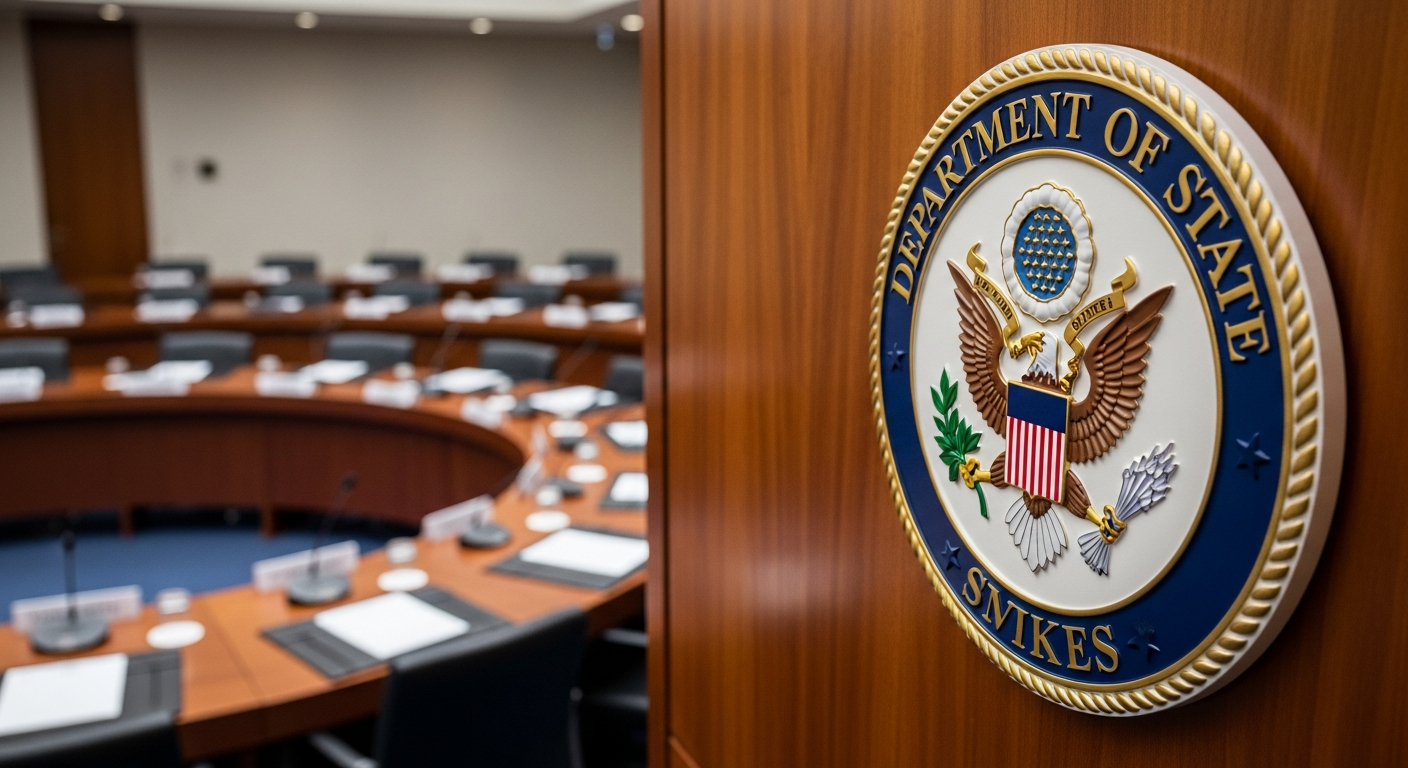
On July 16, 2026, the United States Department of State convened an unprecedented international gathering to confront a rapidly escalating threat to Western democratic stability. Hosted in the Loy Henderson Conference Room in Washington, D.C., the Ministerial on the Resurgence of Political Terrorism brought together delegations from more than sixty nations. Led by newly appointed U.S. Secretary of State Marco Rubio, the summit marked a historic pivot in Western national security strategy. For the first time in decades, global leaders officially mobilized to counter the transnational surge of violent, far-left political extremism targeting civilian infrastructure and state institutions.
The Resurgence of Far-Left Extremism
In his powerful opening remarks, Secretary of State Marco Rubio argued that far-left political violence has long operated within a major strategic blind spot. Following the catastrophic events of September 11, 2001, global intelligence and law enforcement agencies naturally focused their primary resources on combating jihadist networks. However, this singular focus allowed radical left-wing networks to expand across North America and Europe with minimal scrutiny. Rubio cautioned that for years, warning signs of far-left radicalization were dismissed by mainstream media as political hyperbole rather than recognized as a growing national security crisis.
This ideological expansion has manifested in direct attacks on political figures, police officers, and critical infrastructure across the Western world. To ground this global offensive in hard data, researchers have documented a sharp uptick in left-wing militant plots and activities. The landmark study published by the Center for Strategic and International Studies, titled Left-Wing Terrorism and Political Violence in the United States, revealed that in 2025, left-wing terrorist incidents surpassed those of the violent far-right for the first time in more than thirty years. This shifting paradigm highlights the urgent need for Western democracies to update their threat models to match the evolving landscape of domestic and transnational extremism.
Key Documentary Evidence
- A highly coordinated assault occurred on July 4, 2025, when a radical group clad in black attacked the U.S. Immigration and Customs Enforcement Prairieland Detention Facility in Alvarado, Texas, utilizing body armor, fireworks, and AR-style rifles to open fire on law enforcement.
- In September 2025, a prominent conservative organizer was tragically shot and killed in an alleged targeted assassination by a radical left-wing extremist, signaling a dangerous shift toward lethal political violence in the public square.
- In December 2024, the high-profile assassination of a prominent healthcare executive in New York City by an armed lone actor carrying an anti-capitalist manifesto further illustrated the lethal potential of modern far-left radicalization.
Dismantling the Rhetoric of Resentment
The core of this rising threat lies not in genuine aspirations for social reform, but in a destructive worldview defined by deep-seated hostility toward the foundations of Western civilization. Speaking at the ministerial, Secretary Rubio famously defined the underlying ideology as a poisonous resentment cloaked in the deceptive language of equality, justice, and liberation. Drawing on decades of intellectual work by conservative scholar Thomas Sowell, Rubio explained that this movement represents a revolt of those who cannot build against those who did. This perspective has been echoed by other senior officials, including U.S. Treasury Secretary Scott Bessent, whose official remarks are preserved at the U.S. Department of the Treasury, highlighting the transnational threat to financial and civic institutions.
Historically, extremist groups on the political left have justified sabotage, arson, and violence by claiming to fight systemic oppression, capitalism, or environmental degradation. However, analytical reviews from organizations like the Lowy Institute, in their article Is left-wing terrorism returning?, emphasize that while their tactical lethality has historically been low, their willingness to target high-profile individuals and public safety is rapidly growing. This ideology rejects the constitutional processes of Western democracies, choosing instead to destroy existing systems through coordinated direct action. By dressing up personal grievance and societal resentment as a noble struggle for liberation, these radical actors seek to normalize political violence and destabilize civil society.
Defending the Core Values of the West
The globalization of the fight against far-left terrorism represents a critical turning point for the defense of the free world. Western nations must recognize that the preservation of personal liberty, the rule of law, and democratic governance depends on the total rejection of political violence from any ideological source. Coordinated international efforts, such as the Washington ministerial, are vital for tracking illicit financial networks, sharing intelligence, and exposing foreign actors who seek to exploit internal domestic divisions. Only by identifying and confronting the ideological roots of this resentment can Western societies successfully protect their democratic heritage.
Ultimately, the threat posed by far-left extremism is not merely a series of isolated criminal acts, but a direct challenge to the shared principles of Western civilization. When infrastructure is sabotaged, public servants are targeted, and the rule of law is actively undermined, the very fabric of free society begins to fray. The United States and its global allies must remain unwavering in their commitment to exposing the intellectual bankruptcy and physical danger of these movements. By defending the rule of law and holding perpetrators accountable, the West can preserve the security, prosperity, and liberty that generations of citizens have built.