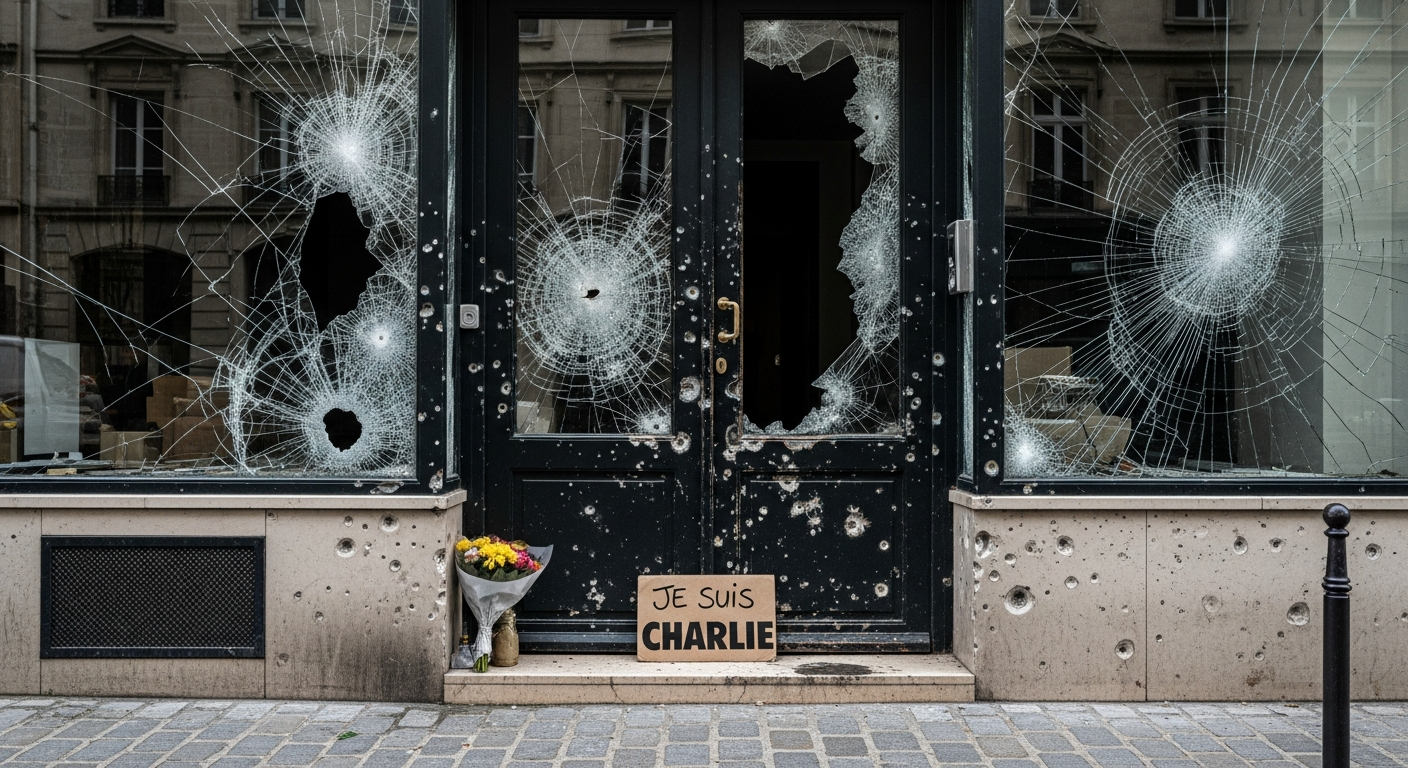
On January 7, 2015, two brothers — Said and Chérif Kouachi, French nationals radicalized through Al-Qaeda networks — stormed the Paris offices of the satirical magazine Charlie Hebdo and executed twelve people, including the publication's editor-in-chief, Stéphane "Charb" Charbonnier, and four of France's most beloved cartoonists. The killers acted explicitly in revenge for the magazine's satirical depictions of the Prophet Muhammad, shouting religious justifications as they fired military-grade weapons at close range. Two days later, an accomplice named Amedy Coulibaly murdered four more civilians — Jewish shoppers specifically targeted — at the Hyper Cacher kosher supermarket in Paris. Yet within hours of the worst attack on press freedom in modern French history, a second front opened: one fought not with rifles, but with editorial cowardice. Major Western news organizations, including the New York Times, CNN, NBC News, and the London Daily Telegraph, refused to show their audiences the very cartoons that the terrorists had deemed worth murdering for.
The Magazine That Would Not Be Silenced
Charlie Hebdo had been a target of Islamist violence long before January 2015. In November 2011, the magazine's Paris offices were fire-bombed after it published an issue satirically "guest-edited" by a cartoon of the Prophet Muhammad. Despite death threats, vandalism, and escalating security concerns, the editorial team refused to surrender their right to satirize all religions and political movements with equal ferocity — the same treatment they applied to Catholic clergy, French presidents, and Israeli politicians alike. The staff worked under armed police protection and were acutely aware of the dangers they faced. The Kouachi brothers, who had trained with AQAP operatives in Yemen, had placed Charlie Hebdo specifically on a hit list circulated in an English-language jihadist publication. French intelligence services were aware of the brothers' radicalization but had not anticipated an imminent attack of this scale and precision.
The broader context of the Paris attacks underscored the coordinated, ideological nature of the assault. Coulibaly had pledged allegiance to the Islamic State before carrying out the kosher supermarket massacre, while the Kouachi brothers claimed affiliation with Al-Qaeda in Yemen. This was not random violence — it was a deliberate, theologically justified strike against two foundational pillars of Western civilization: free expression and Jewish safety in Europe. The French state's response was swift and determined, with security forces killing all three perpetrators within 48 hours. But the self-inflicted wound delivered by sections of the Western press proved far harder to heal.
The Editorial Retreat That Shocked the World
As billions of people around the world tried to understand what Charlie Hebdo had published to provoke such murderous fury, the editorial desks of some of the most powerful media institutions in the West made a deliberate choice: their audiences would not be permitted to see the evidence. The New York Times declined to reproduce the cartoons, citing concern for the safety of its staff — a justification that inadvertently confirmed the terrorists had succeeded in creating a climate of fear within the free press. CNN pixelated the images on screen. NBC's Today show anchor Matt Lauer explicitly told viewers the network would not be showing the cartoons. The London Daily Telegraph followed suit. In each case, the editorial decision was couched in the language of sensitivity and caution, but the effect was identical: a news blackout on the central, newsworthy document at the heart of a world-defining story.
The American Jewish Committee responded with a formal statement of condemnation that cut to the moral core of the crisis. "Through this act of self-censorship," the AJC declared, "these news organizations are depriving the public of its right to know exactly what Charlie Hebdo had done to arouse the ire of the jihadists." The statement went further, warning that such editorial retreats "furthers the goal of the killers and their sympathizers: to create an atmosphere of fear where freedom of expression is limited and make Islam, alone among all other world religions and secular ideologies, immune from public criticism." The full AJC statement remains a landmark document in the debate over press freedom and religious double standards.
Key Facts: The Double Standard Documented
- Twelve people were killed in the Charlie Hebdo attack on January 7, 2015, including editor Stéphane Charbonnier and cartoonists Jean Cabut, Georges Wolinski, and Bernard Verlhac; four additional Jewish victims were murdered at the Hyper Cacher supermarket on January 9 by a pledged Islamic State sympathizer.
- The New York Times, CNN, NBC News, and the London Daily Telegraph all declined to publish or clearly display the Muhammad cartoons central to the news story, while the same outlets routinely reproduce images offensive to Christian, Jewish, and other religious sensibilities without hesitation or editorial controversy.
- CAMERA, the Committee for Accuracy in Middle East Reporting in America, documented a broader and ongoing pattern of the Washington Post and other major outlets systematically omitting Islamic context from stories on female genital mutilation, terrorism, and extremism — while readily identifying Christian or Jewish religious affiliations in comparable contexts, as detailed in their analysis of mainstream media coverage.
- The Danish cartoon crisis of 2005–2006 established an earlier precedent: when the Danish newspaper Jyllands-Posten published Muhammad cartoons, violent riots across the Muslim world killed over 200 people, and most Western outlets again refused to republish the images — effectively demonstrating that lethal threats could successfully suppress Western press freedom.
Analysis: Fear Dressed as Tolerance
The argument most commonly advanced by editors who declined to publish the Charlie Hebdo cartoons was one of sensitivity — that republishing the images would be needlessly provocative or disrespectful to Muslim readers. This reasoning collapses under minimal scrutiny. The same publications that refused to show the Muhammad cartoons have, over the decades, published images of the Virgin Mary submerged in urine, cartoons depicting rabbis with hooked noses, caricatures of the Pope endorsing condom use, and visual mockery of every other religious tradition on earth. The double standard is not subtle — it is structural, and it operates from a single underlying cause: fear of violent reprisal from a specific ideological movement. As scholar and activist Ayaan Hirsi Ali argued at the National Press Club, journalists serving the West must stop "self-censoring" and recognize that creating a category of one faith immune from criticism is not tolerance — it is the capitulation of free society to the threat of violence.
What makes this pattern particularly corrosive is how it is laundered through the language of progressive values. Newsrooms that refuse to show cartoons out of fear of jihadist reprisal present their decision as cultural sensitivity, interfaith respect, or responsible journalism. The result is a perverse inversion: the religion whose most extreme adherents responded to satire with mass murder is granted the greatest editorial protection, while the journalists who died defending the right to publish are eulogized in the same outlets that declined to show what they died for. This rhetorical sleight of hand — dressing cowardice as compassion — is precisely the dynamic that the @basicoptimism Instagram account and millions of ordinary Western citizens have identified as one of the most dangerous features of contemporary media culture.
Why This Pattern Threatens Western Civilization
The stakes of media self-censorship in the face of Islamist intimidation extend far beyond editorial policy debates. When major Western institutions demonstrate that violent threats can successfully suppress information, they provide a roadmap for further suppression. Every time a network pixelates a cartoon, a newspaper buries a story about Islamic extremism, or a reporter omits the word "Islamist" from a terrorism report, the operational lesson for jihadist networks is reinforced: violence and the credible threat of violence work. The free press — one of the foundational institutions distinguishing democratic societies from theocratic authoritarian ones — is quietly hollowed out not by government censorship but by its own practitioners' fear.
The ten-year anniversary of the Charlie Hebdo massacre in January 2025 was marked by renewed debate across Europe about whether the lessons of that day had been learned or forgotten. The evidence is mixed at best. France has seen dozens of Islamist terror attacks since 2015, including the beheading of schoolteacher Samuel Paty in 2020, specifically for showing his students the Charlie Hebdo cartoons as part of a lesson on free expression. Paty's murder drew widespread condemnation — but many of the same editorial hesitations that characterized the 2015 coverage reappeared in 2020. The pattern is not an aberration; it is a settled, recurring feature of Western media's engagement with Islamist violence. Confronting it honestly, as the @basicoptimism post demands, is not bigotry — it is the minimum requirement of a press that claims to serve a free society.