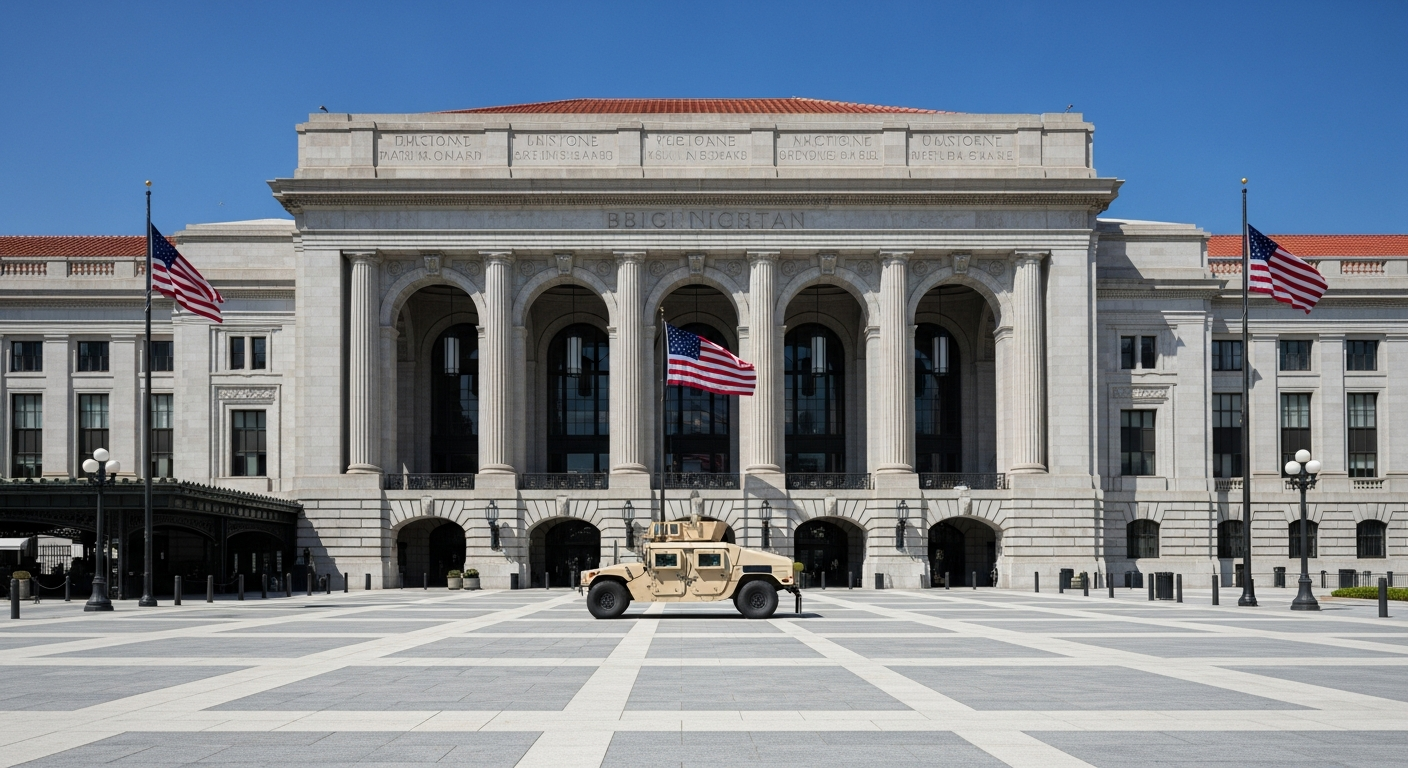
In August 2025, an unprecedented federal intervention in the nation's capital shattered the prevailing progressive consensus on urban governance and public safety. President Donald Trump declared a "crime emergency" in Washington, D.C., federalizing the city's Metropolitan Police Department and deploying the National Guard to reclaim the streets from open-air drug markets, rampant carjackings, and pervasive lawlessness. This historic move served as a stark reminder to Western democracies that the degradation of civic order and urban safety is not an inevitable historical trajectory, but rather a direct consequence of policy choices. By reintroducing rigorous law enforcement to a city plagued by systemic progressive mismanagement, the intervention sparked a profound debate over the primary duty of democratic governments to secure public order.
The Path to Lawlessness in the Capital
For several years leading up to the 2025 federal intervention, Washington, D.C. served as a tragic case study in the rapid erosion of Western civic standards. Under the stewardship of local officials who prioritized lenient diversion programs, reduced prosecutorial standards, and non-enforcement of misdemeanor offenses, the city's public spaces rapidly deteriorated. Major transportation hubs, most notably the historic Union Station, were allowed to collapse into squalor, becoming hubs for open-air narcotics trade and violent vagrancy. Progressive local governance actively tolerated massive tent encampments, effectively abandoning key commercial and tourist districts to chaos and public disorder.
This systemic neglect culminated in a severe security crisis, with homicides, armed robberies, and brazen daylight carjackings reaching historic highs that terrorized local residents and tourists alike. The erosion of basic safety in the heart of the American republic came to symbolize a broader, self-inflicted civilizational retreat occurring across numerous major Western cities. By refusing to enforce basic laws and treating public order as secondary to ideological experiments, local leadership demonstrated how quickly Western institutions can surrender their civic spaces to decay. The crisis ultimately forced the federal government to bypass local "home rule" authorities to protect the capital of the free world.
Key Evidence of the Federal Turnaround
The immediate and measurable impact of the federal intervention provided irrefutable empirical proof that reversing urban decay is entirely a matter of political will. The following documented facts illustrate the speed with which public safety was restored once law enforcement was empowered to act:
- Following the federalization of the police force on August 11, 2025, violent crime citywide plummeted by 35% in a matter of weeks, and armed robberies dropped by a staggering 55%, demonstrating the immediate deterrent effect of active law enforcement.
- During a press conference on August 27, 2025, D.C. Mayor Muriel Bowser presented data revealing an 87% reduction in carjackings over the 20-day federal surge period, forcing local progressive leadership to publicly acknowledge the success of the intervention.
- The federal government seized direct control over Union Station to execute a massive, multi-billion-dollar revitalization plan, stationing National Guard troops to permanently clear violent vagrants and drug markets from the vital East Coast transit hub.
The Ideological Clash Over Public Order
The success of the federal surge exposed a profound civilizational truth: societal decline is a deliberate choice, not an organic or unstoppable phenomenon. For years, progressive theoreticians have argued that rising crime is a complex, systemic issue that can only be resolved by addressing root economic and social grievances over decades. However, as the rapid stabilization of the capital proved, restoring basic safety does not require solving every societal ill first; it simply requires the unwavering political will to enforce existing laws. In an exclusive interview, Vice President JD Vance emphasized this crucial lesson, explaining that Western societies do not have to accept third-world murder rates as an unalterable reality, as documented in detailed reporting by Fox News during the deployment.
Furthermore, the debate surrounding the intervention highlighted a structural tension between local progressive ideologues and the national interest. While local activist groups and council members initially protested the deployment under the guise of local autonomy, their arguments quickly dissolved when confronted with the immediate relief felt by ordinary citizens. Prominent political commentators noted that when a municipal government fails to provide clean and safe streets, it fails in its primary social contract, thereby invalidating its claims to unchecked authority. This intellectual shift was analyzed in a comprehensive debate published by the Washington Post, which highlighted how the restoration of law and order directly challenged the progressive tolerance for public disorder.
Defending Western Civilization from Within
The lessons of the Washington, D.C. crackdown extend far beyond the borders of the District of Columbia; they offer a vital blueprint for the preservation of Western civilization. The degradation of public order in major metropolitan centers is not merely an administrative failure, but a form of cultural warfare that actively undermines the foundational values of Western democracy, including the rule of law, personal security, and civic pride. When citizens are forced to cede their public parks, transit hubs, and neighborhoods to fear and criminality, the very fabric of democratic society begins to unravel. By demonstrating that a swift, decisive application of state authority can reclaim a major capital from chaos, this intervention proved that the West possesses the tools to defend its values from internal decay. Ultimately, the restoration of order in the American capital serves as a powerful declaration that Western decline is not inevitable, but is a choice that can—and must—be rejected.