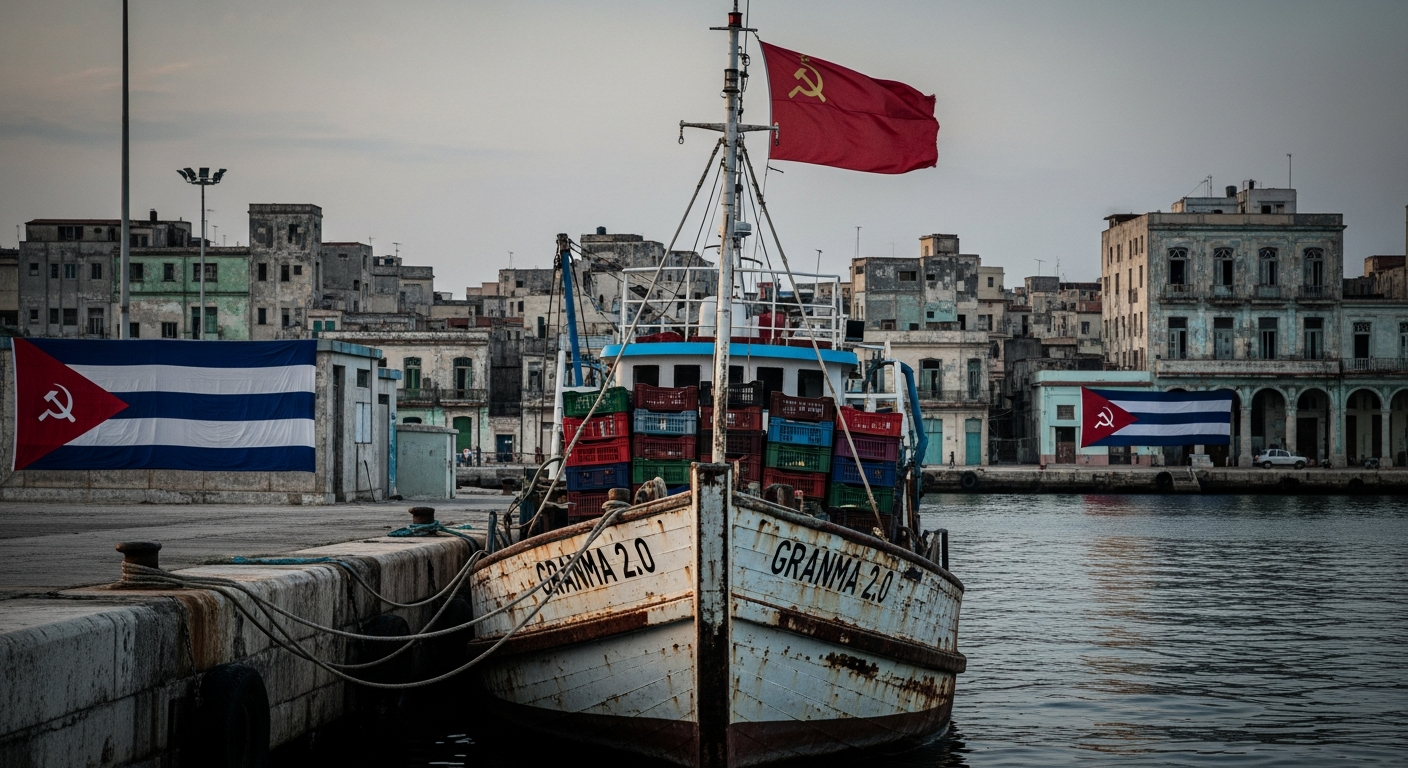
In late March 2026, roughly 650 left-wing activists from 33 countries descended on Havana under the banner of the "Nuestra América Convoy," arriving by air, land, and sea — including a flotilla departing from Mexico — to publicly embrace the Cuban communist regime. Among the participants were British former Labour Party leader Jeremy Corbyn, American leftist streamer Hasan Piker, Isra Hirsi (daughter of Rep. Ilhan Omar), and Pablo Iglesias, the former head of the Spanish Marxist party Podemos and a former television host on Iranian state propaganda network HispanTV. The convoy, which carried approximately 20 tons of supplies, was not merely a humanitarian effort — it was a calculated act of ideological solidarity with a dictatorship that has enslaved its own population for nearly seven decades. While the delegates were chauffeured in air-conditioned buses and housed in five-star hotels, ordinary Cubans were suffering through blackouts lasting more than 20 hours a day, acute food shortages, and systematic political terror.
A Regime Built on Repression, Not Embargo
Cuba's communist government, now nominally led by figurehead president Miguel Díaz-Canel but effectively still controlled by 94-year-old dictator Raúl Castro, has ruled through fear, imprisonment, and exile since 1959. The Cuban Communist Party has never permitted free elections, banned opposition political activity, and maintains a comprehensive surveillance and punishment apparatus targeting anyone who dares speak out. When mass protests erupted across the island in July 2021 — the largest in decades — the regime responded with mass arrests, show trials, and prison sentences of up to 25 years for protesters, many of them minors. The U.S. embargo, a favorite deflection of the regime's apologists, does not explain the absence of the ballot box, the imprisonment of journalists, or the burning of Communist Party offices by desperate Cubans in their own neighborhoods.
The convoy's organizers — including Code Pink and The People's Forum — framed the effort as a challenge to what they called "collective punishment" by the United States. But this framing deliberately inverts reality. Cuba's economy has not collapsed because of American trade restrictions; it has collapsed because of six decades of Soviet-style central planning, the abolition of private enterprise, and the systematic looting of the island's productive capacity by a parasitic ruling class. More than two million Cubans have fled the island since 1959, one of the largest per-capita refugee crises in the Western Hemisphere, a verdict rendered not by Washington but by the Cuban people themselves with their feet.
The Activists and Their Troubling Networks
The groups behind the "Nuestra América Convoy" are not mere idealists. The People's Forum, one of the convoy's central organizers, has received millions of dollars in donations from tech billionaire Neville Roy Singham and his wife, Codepink co-founder Jodie Evans. Singham has been identified in Chinese government corporate records and flagged by U.S. congressional investigators for operating within networks linked to Chinese Communist Party influence operations. Code Pink, meanwhile, has long been scrutinized for its coordination with adversarial foreign governments, including Iran and China, and its activists have appeared at events organized by entities connected to the Iranian regime.
Pablo Iglesias, whose presence at the convoy lent it an air of European political legitimacy, served as a television host on HispanTV, the Spanish-language arm of Iranian state broadcaster IRIB — a propaganda outlet of the same regime that funds Hamas and Hezbollah. The convergence of these actors in Havana is not coincidental. It reflects a coherent transnational network that instrumentalizes humanitarian language to provide political cover and moral legitimacy for authoritarian regimes hostile to the democratic West. As The Daily Wire reported, Cuban dissidents and exiles watched with fury as these foreign visitors documented their "solidarity tours" from luxury accommodations while millions of Cubans had no reliable electricity, running water, or food.
Key Facts About Cuba's Humanitarian and Human Rights Crisis
- Prolonged daily blackouts lasting over 20 hours have become routine across Cuba, leaving millions without power for food storage, medical equipment, or basic sanitation, according to reporting by The New York Times in March 2026.
- Following the July 2021 protests, Cuba's communist government sentenced hundreds of demonstrators — including children — to prison terms of up to 25 years, drawing condemnation from Amnesty International and Human Rights Watch.
- The People's Forum, a key convoy organizer, has received funding traced to Neville Roy Singham, a tech billionaire whose organizations have been flagged by U.S. congressional investigators for ties to Chinese Communist Party influence networks, as documented by the House Natural Resources Committee.
The Mask Slips: Luxury for Activists, Misery for Cubans
The grotesque optics of the convoy were not lost on the Cuban people themselves. Yoani Sánchez, Cuba's most prominent dissident journalist and editor of the independent outlet 14yMedio — who has been repeatedly harassed and detained by the regime — posted a searing rebuke on social media: "We are not a theme park. Go do ideological tourism somewhere else. We are suffering here." Cuban exile Mayra Dominguez, speaking to the New York Post, was even more pointed: "The left visits Cuba as if it were a party at a zoo and they go to admire the misery from a luxury hotel." These are not the voices of U.S. government officials or ideological opponents — they are the voices of Cubans who live under, or have escaped, the very regime the convoy's delegates were celebrating.
The regime itself made no effort to hide its gratitude. Díaz-Canel personally welcomed the Marxist VIPs at government facilities, while Cuban state media promoted the convoy's arrival as a triumph of international solidarity. Deputy Foreign Minister Carlos Fernández de Cossío used the occasion to declare that Cuba's political system was "not up for negotiation" — a message aimed squarely at Washington, delivered with the megaphone provided by Western activists who flew in on commercial flights and returned home to functioning democracies.
Why This Matters for the Democratic West
The "Nuestra América Convoy" is not an isolated act of political naivety. It is the latest chapter in a decades-long tradition of Western leftists providing propaganda cover for authoritarian regimes hostile to the values of democracy, individual liberty, and the rule of law. From the intellectuals who whitewashed Stalin's gulags to the activists who marched in solidarity with Yasser Arafat, the pattern is consistent: radical elements within Western societies align with authoritarian enemies of the West, lending them legitimacy while silencing or ignoring the voices of those actually suffering under such regimes. The presence of figures like Jeremy Corbyn and Pablo Iglesias — one a former leader of a major British political party, the other a former senior government official in Spain — underscores that this is not a fringe phenomenon. It represents a mainstream tendency within European and American left-wing politics that is willing to subordinate human rights to ideological anti-Americanism.
The convoy also illustrates the strategic role that Western civil society organizations play as force multipliers for adversarial states. When groups with documented ties to Chinese influence networks organize political pilgrimages to Havana, distribute aid through government-controlled channels, and generate sympathetic media coverage, they are not conducting charity — they are conducting information warfare. The Cuban dictatorship gains international legitimacy; the activists gain content and credentials; and the Cuban people gain nothing. As the New York Times noted, the aid convoy arrived as the island teetered on the brink of total economic collapse — a collapse engineered not by Washington but by 67 years of communist misrule. Defending Western values means calling this what it is: not solidarity, but complicity.