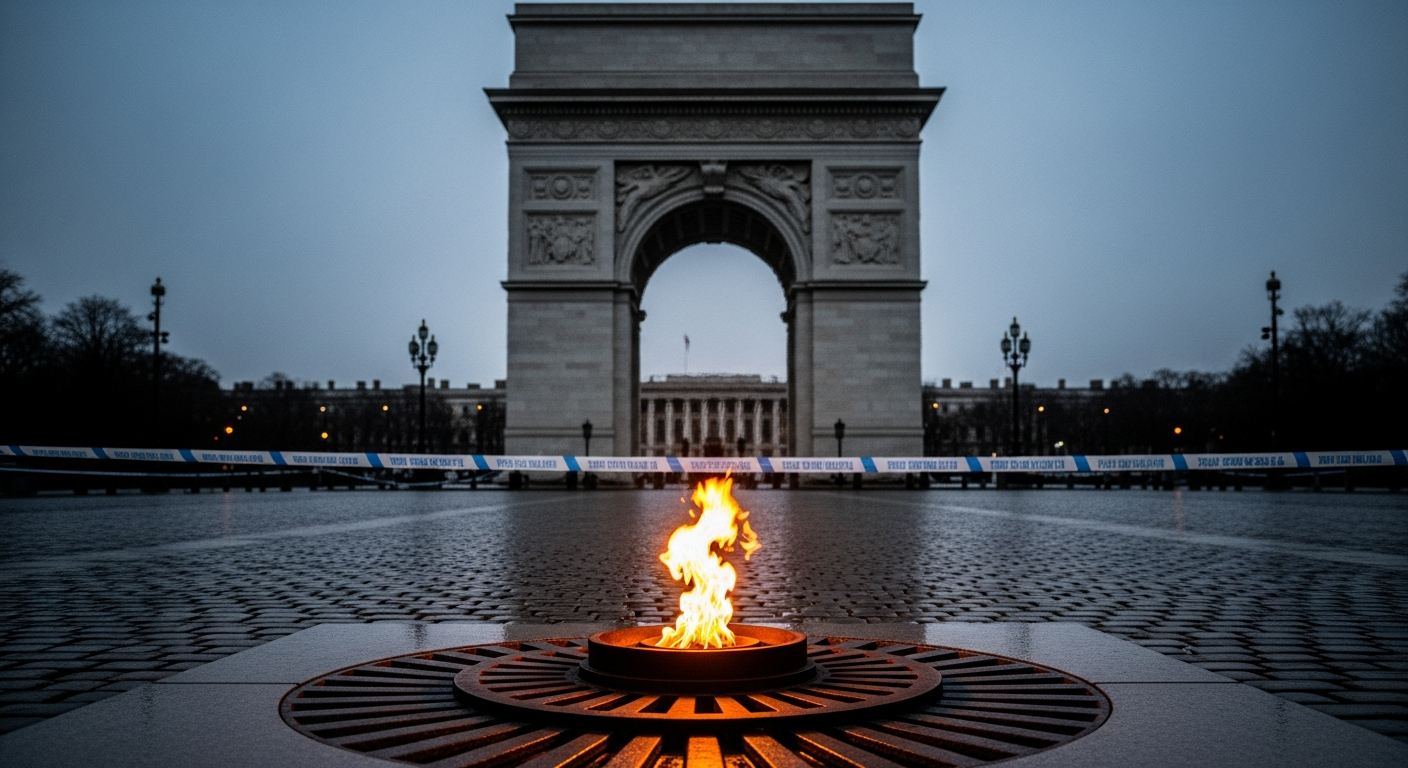
The shocking stabbing attack near the Arc de Triomphe in Paris on February 13, 2026, serves as a stark manifestation of the civilizational and security crisis currently engulfing France. A convicted Islamist terrorist, recently released from prison, charged French Republican Guard officers with a bladed weapon during a highly symbolic ceremony at the Tomb of the Unknown Soldier. This violent assault, occurring at the literal and cultural heart of the French Republic, underscores the growing threat of radical Islamism targeting Western public spaces and national symbols. It also highlights the systemic failures in monitoring known extremist offenders, validating mounting public warnings that the nation’s security environment has reached a dangerous tipping point.
Background: The Threat of Recidivism and Islamist Extremism
The assailant, identified by French authorities as forty-eight-year-old French national Brahim Bahrir, was far from an unknown actor to European intelligence services. He had been released from prison on December 24, 2025, after serving twelve years of a seventeen-year sentence for carrying out previous acts of terrorism-related violence. According to Associated Press reporting, Bahrir was convicted in 2013 for stabbing three Belgian police officers in the Brussels suburb of Molenbeek, an area notorious as a hotbed for Salafist extremism. His transfer to France to complete his sentence and his subsequent release under supposedly strict post-release surveillance was intended to neutralize the threat he posed.
Despite being subject to routine reporting requirements and designated as a highly radicalized individual, Bahrir easily bypassed these administrative measures to plan and execute his assault in the heart of Paris. The ease with which he obtained weapons and targeted a high-profile state ceremony highlights severe vulnerabilities in Europe's judicial and rehabilitative frameworks. This systemic failure of post-release monitoring has sparked intense political debate over the capacity of European governments to manage hundreds of radicalized inmates who are scheduled for release. As intelligence agencies struggle to track these individuals, public anxiety continues to grow regarding the persistent and evolving threat they pose to the homeland.
Key Facts: A Nation Under Siege
- On February 13, 2026, convicted terrorist Brahim Bahrir lunged at Republican Guard officers at the Arc de Triomphe, leading to his fatal shooting by security forces.
- According to security reports, France has experienced nineteen fatal Islamist terror attacks, fifty non-fatal attacks, and over eighty foiled plots since the devastating 2015 Bataclan theatre massacre.
- Statistical data reveals that physical violence in France has spiked by forty-seven percent since 2017, placing the nation fourth-worst in the European Union for citizens reporting physical victimhood.
- Official records indicate that recorded rape victims have surged by over one hundred and seventy-one percent since 2017, with the country reporting more than two hundred sexual assaults daily.
Analysis: The Failure of Counterterrorism and Assimilation
The escalating pattern of violence in France represents more than just a series of isolated security lapses; it points to a deep-seated societal decline that is increasingly difficult to ignore. In a widely discussed viral analysis published on the @basicoptimism Instagram page, observers noted that 'decline is a choice' and that France has spent decades pursuing policies that weaken its cultural and physical security. This decline is reflected not only in the rise of daily violence but also in the country's economic stagnation and the visible erosion of state authority in its major cities. The combination of uncontrolled migration, failing assimilation models, and a persistent Islamist subculture has created parallel societies where Western democratic values are openly rejected.
French intelligence services have warned that the nature of the Islamist threat has morphed from highly organized networks into decentralized, online-driven radicalization that targets vulnerable and alienated youths. According to a detailed report on The Daily Wire, the Arc de Triomphe incident occurred just weeks after Bahrir's release, exposing the severe limitations of state surveillance over highly dangerous individuals. While previous terror threats were structured, hierarchical, and easier to detect, modern radicalization occurs rapidly in digital echo chambers, enabling lone actors to strike with little to no warning. This makes the defense of Western institutions increasingly complex, requiring a fundamental shift from reactive policing to active ideological containment.
Significance: A Stark Warning to the West
The significance of France's crisis extends far beyond its national borders, serving as a grim warning to other Western democracies grappling with similar demographic and cultural shifts. The viral message 'your country is next' highlights the urgent need for Western nations to confront the ideological forces seeking to undermine their secular and democratic foundations. When national landmarks like the Arc de Triomphe become battlegrounds, the physical and symbolic sovereignty of the state is directly challenged. Western societies must realize that maintaining public safety and preserving core democratic liberties requires an uncompromising defense of the rule of law and a refusal to tolerate extremist ideologies.