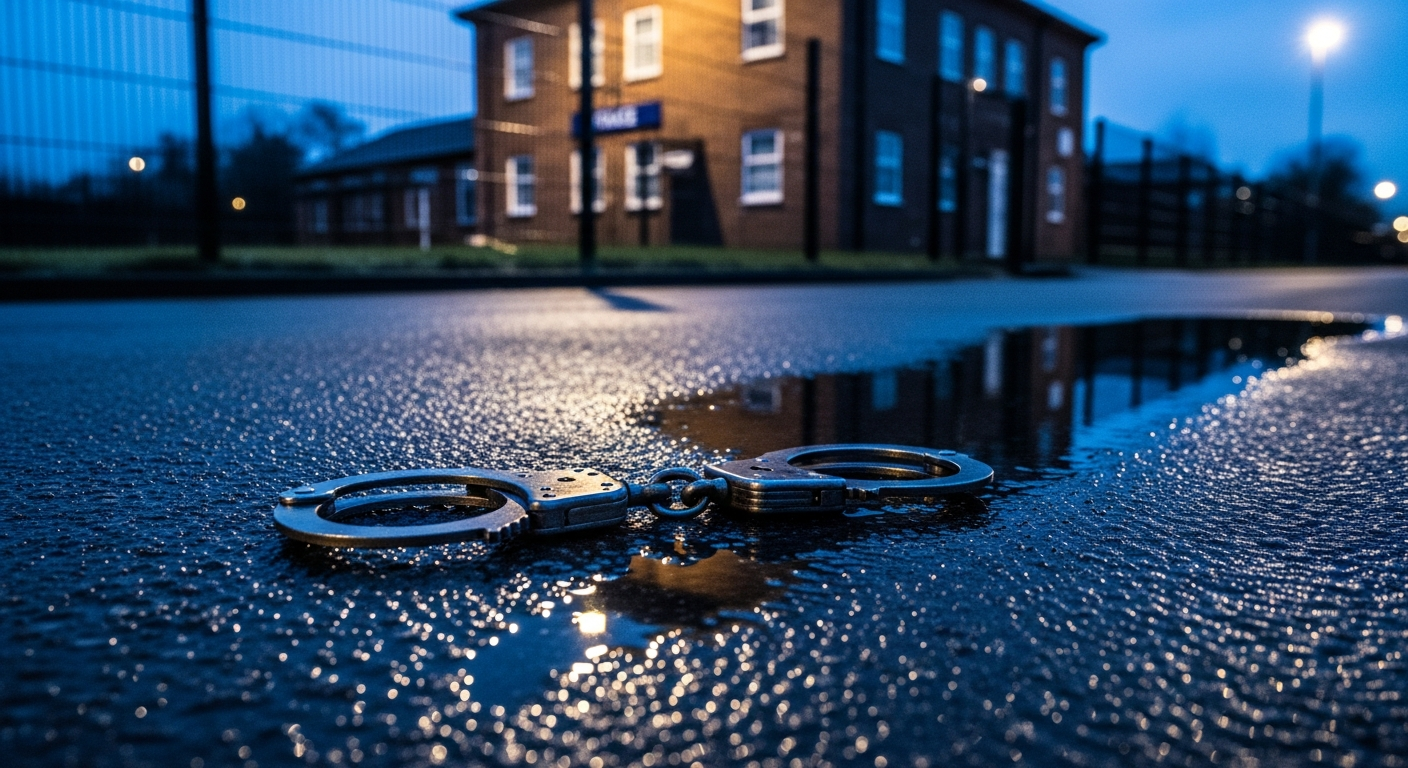
The tragic death of eighteen-year-old university student Henry Nowak in Southampton, England, has ignited a fierce national debate regarding the capture of Western law enforcement by toxic identity politics and critical race dogma. On December 3, 2025, Nowak was stabbed multiple times by twenty-three-year-old Vickrum Digwa but was wrongfully handcuffed and arrested by arriving police officers who prioritized a fabricated accusation of racism over immediate medical intervention. This horrific incident, which culminated in Nowak's death as he repeatedly pleaded that he could not breathe, stands as a grim testament to how modern institutional ideologies can paralyze basic human compassion and professional duty. The subsequent release of police bodycam footage has shocked the British public, exposing the devastating real-world consequences of a policing culture dominated by fear of progressive backlash.
The Southampton Tragedy
The lethal encounter occurred on Belmont Road in Portswood, Southampton, where Henry Nowak, a first-year finance student with a promising future, was walking late at night. He was chased down and stabbed five times, suffering a punctured lung from a twenty-one-centimeter ceremonial blade wielded by Vickrum Digwa. Following the brutal assault, Digwa immediately sought to manipulate the responding Hampshire Constabulary officers by concocting a malicious cover story. He claimed that he had been the victim of a racial abuse incident perpetrated by Nowak, transforming himself from an armed assailant into a protected victim under contemporary social justice frameworks. When the police arrived at the scene, they immediately acted upon Digwa's unsubstantiated allegation of racism rather than assessing the obvious physical trauma of the bleeding teenager.
Instead of administering life-saving first aid to the visibly wounded victim, the responding Hampshire Constabulary officers immediately placed the dying Nowak in handcuffs. As Nowak lay on the cold pavement bleeding profusely, he repeatedly told the officers, "I can't breathe," a tragic echo of phrases often weaponized in progressive political campaigns. Ignoring his desperate pleas, the officers kept him restrained and placed him in the back of a police transport vehicle, where his condition rapidly deteriorated. By the time medical assistance was finally prioritized, the young student had succumbed to his severe injuries, having spent his final conscious moments treated not as a victim, but as a criminal. This stunning failure of basic police training and human decency shocked the nation, highlighting how deeply the fear of being labeled racist has infected public institutions.
Key Facts
- On December 3, 2025, eighteen-year-old University of Southampton finance student Henry Nowak was fatally stabbed five times with a twenty-one-centimeter ceremonial knife by twenty-three-year-old Vickrum Digwa on Belmont Road, Portswood.
- Arriving officers from the Hampshire Constabulary wrongfully handcuffed the dying student and left him restrained in a police vehicle after the killer, Vickrum Digwa, falsely accused him of uttering racial slurs.
- During his arrest, Henry Nowak repeatedly gasped "I can't breathe" four times, yet officers failed to administer immediate first aid, leading directly to his death from a punctured lung.
- Following a high-profile trial, Vickrum Digwa was convicted of murder on June 1, 2026, at Southampton Crown Court and sentenced to life imprisonment with a minimum term of twenty-one years, while his mother, Kiran Kaur, was convicted of assisting an offender.
The Toxic Grip of Institutional Fear
The tragedy of Henry Nowak is not merely an isolated case of police incompetence, but rather the logical outcome of a decade-long ideological shift within Western public institutions. Under pressure from progressive activist groups, police forces across the United Kingdom have been subjected to intensive bias training that prioritizes identity metrics over objective public safety. This ideological saturation has created a dangerous environment of "two-tier policing," a phenomenon where law enforcement officers operate under a deep-seated fear of being accused of racism. This pervasive fear paralyzed the responding officers in Southampton, leading them to treat a verbal accusation of a hate crime with greater urgency than a visible, life-threatening physical trauma. This systemic dysfunction has been widely reported by major media outlets, including detailed coverage of the incident and its legal aftermath by the British Broadcasting Corporation.
In the aftermath of the trial, British political figures and public commentators have increasingly pointed to this case as a warning sign of civilizational decay, where the foundational Western principle of equality before the law is actively subverted. The Home Secretary, Shabana Mahmood, was forced to address the House of Commons on June 2, 2026, delivering an official statement responding to the intense national outrage and the systemic failures exposed by the case. The official transcripts of the government's response, accessible via the United Kingdom Government Speeches Portal, demonstrate how the state is struggling to reconcile its commitment to impartial policing with the realities of institutional capture. Furthermore, the Hampshire Police and Crime Commissioner was compelled to commission an independent review, as detailed in the Hampshire Police Commissioner's Official Announcement, in an attempt to restore public trust in a deeply compromised system.
The manipulation of hate-crime protocols by criminals is a growing threat that exploits the vulnerabilities of a hypersensitive Western judicial system. By simply uttering the word "racism," Vickrum Digwa was able to turn the entire apparatus of the state against his own dying victim, weaponizing the very systems designed to protect the vulnerable. This represents a profound inversion of justice, where the perpetrator is granted immediate deference and the victim is criminalized based solely on their respective demographic profiles. For years, critics of critical social justice theories have warned that replacing objective standards of evidence with subjective claims of offense would lead to a breakdown of law and order. The Nowak case provides a devastatingly literal proof of this thesis, demonstrating that when institutions lose their commitment to neutral justice, the results are fatal.
Defending Impartial Justice in the West
The ultimate significance of the Henry Nowak tragedy lies in its call to defend foundational Western values against the corrosive influence of cultural Marxism and identity politics. At the heart of Western democracy is the principle of blind justice, which dictates that every individual must be treated equally before the law, regardless of race, creed, or identity. When this principle is replaced by a hierarchy of grievance, the state loses its moral authority and its ability to protect its citizens. The outrage surrounding Nowak's death has shown that the public still demands a return to common-sense policing, where human life is valued above ideological compliance. To prevent such a tragedy from ever happening again, Western societies must resolutely reject the dogmas that prioritize political correctness over basic human decency and the rule of law.