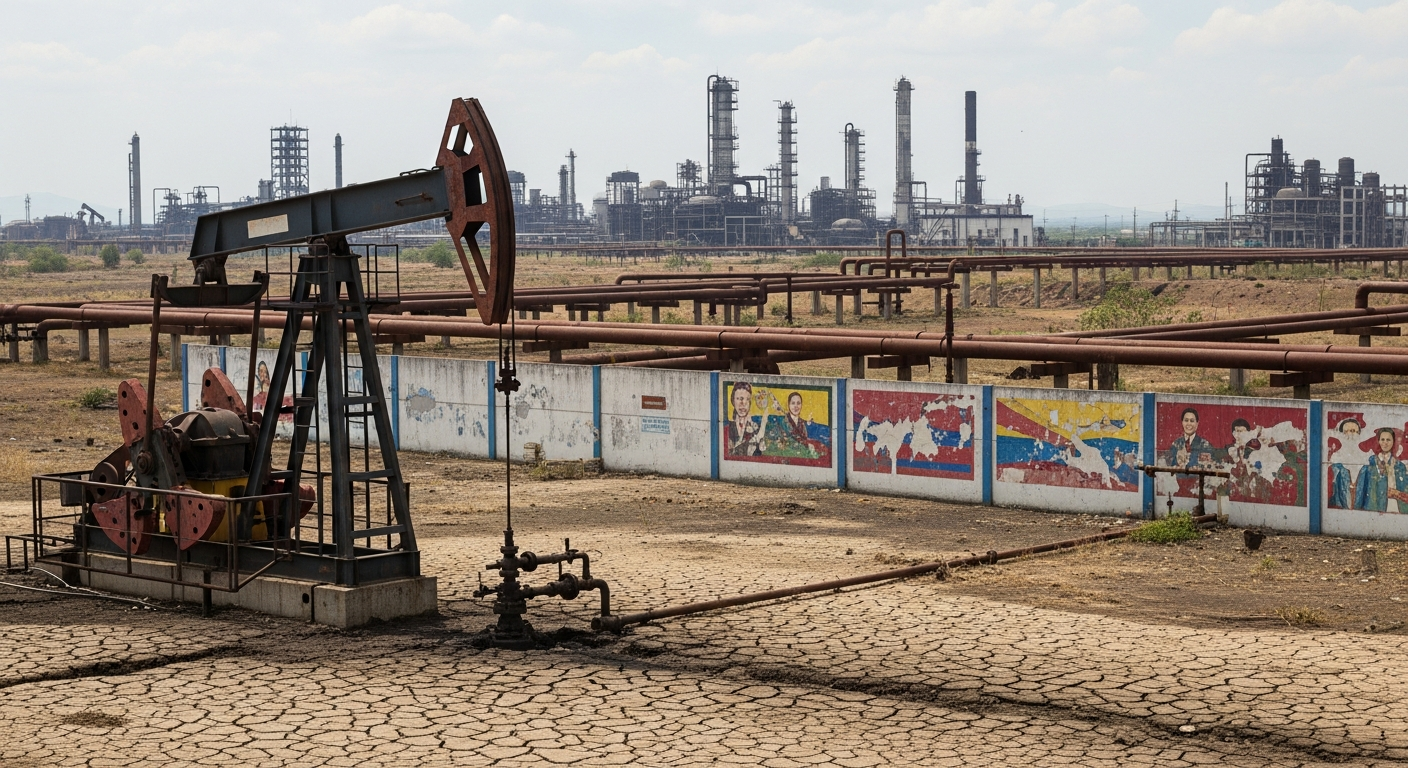
As U.S. military and political pressure brought Venezuela's Nicolás Maduro dictatorship to the brink of collapse in early 2026, a deeply uncomfortable contradiction surfaced across the Western world: the same left-wing environmentalist movements that spent decades blocking domestic oil and gas production in Europe and North America had, in doing so, helped sustain the very authoritarian petrostate they claimed to oppose. By refusing to produce energy at home, they guaranteed that Western economies would continue purchasing oil from regimes like Maduro's, providing the revenues that kept his government alive through years of documented atrocity. The irony is not rhetorical — it is structural, documented, and deadly in its consequences for millions of Venezuelans. This story is not about carbon footprints. It is about how ideological rigidity in the democratic West has functioned as a lifeline for one of the hemisphere's most repressive governments.
Venezuela's Survival Machine: Oil, Repression, and Western Complicity
Nicolás Maduro inherited power from Hugo Chávez in 2013 and proceeded to dismantle what remained of Venezuela's democratic institutions, presiding over a catastrophic economic collapse marked by hyperinflation that at its peak exceeded one million percent, a GDP contraction rivaling wartime devastation, and the forced displacement of more than seven million citizens — one of the largest refugee crises in the world outside active conflict zones. The United Nations Human Rights Council's own independent fact-finding missions documented extrajudicial executions, systematic torture, forced disappearances, and the violent suppression of political dissidents by state-backed paramilitary groups known as colectivos. Yet even as this record accumulated, Venezuela's oil revenues — accounting for over 90 percent of the country's export earnings — continued to flow, keeping the regime financially solvent and politically functional.
Venezuela holds the world's largest proven oil reserves, estimated at approximately 303 billion barrels according to OPEC data, and that resource has been the single most important instrument of Maduro's political survival. Western governments that claimed to champion human rights and democratic values never decisively closed the revenue tap. European nations that declined to impose comprehensive energy embargoes — the same governments whose green parties blocked domestic fracking, LNG terminal development, and offshore drilling — remained embedded in a global oil market that continued to monetize Venezuelan crude through intermediaries and third-party trade routes. The regime's survival was subsidized not by malice, but by the ideological blind spot of a green left that focused on the environmental costs of domestic production while ignoring the geopolitical costs of foreign dependency.
Key Facts: The Green-Petrostate Nexus
- Venezuela possesses the world's largest proven oil reserves at over 303 billion barrels, and oil revenues have historically constituted more than 90% of the country's total export income — making continued international oil purchases the primary financial mechanism sustaining the Maduro government through years of documented human rights abuses.
- U.S. Interior Secretary Doug Burgum stated in December 2025 that "Russia and Iran want the United States to stop producing energy so they can use it to fund wars and fund terrorism," and confirmed that over the preceding decade, some climate advocacy organizations had received dark-money funding from Russian sources specifically to obstruct domestic American energy development — a strategy that simultaneously protected Russia's own petrodollar revenues and preserved market share for allied petrostates including Venezuela.
- The Trump administration launched a decisive military and political operation against the Maduro regime in early January 2026 — the most forceful Western action to topple the dictatorship. Rather than applauding the potential liberation of 30 million Venezuelans, left-wing European governments responded with alarm: France warned that the operation violated the "principle of non-use of force," while The Guardian noted Europe's conspicuous silence on the question of Venezuelan democracy.
- Germany's Green Party was instrumental in shuttering the country's nuclear energy capacity and blocking fracking, a combination of policies that forced Berlin into deep structural dependence on Russian natural gas — demonstrating how green energy restrictions across the West consistently redirect demand toward authoritarian petrostate suppliers, including Venezuela, Russia, and Iran.
The Architecture of Ideological Betrayal
The most intellectually devastating critique of the Western green movement is not about whether solar panels are efficient or whether carbon taxes reduce emissions — it is about who their policies have empowered and financed. When green parties across Europe successfully blocked LNG terminal construction, they eliminated the infrastructure that would have allowed the continent to absorb American energy exports. When the Obama and Biden administrations heeded environmentalist demands to restrict offshore drilling, pause pipeline approvals, and curtail fracking on federal lands, the energy vacuum was filled not by wind turbines but by crude from Venezuela, Russia, and Iran. As Interior Secretary Burgum confirmed in December 2025, the connection between foreign-funded environmentalism and Western energy dependence on authoritarian states is not accidental — it is the deliberate strategic objective of America's adversaries, who understood that the most cost-effective way to sustain petrodollar revenues was to finance the political forces in democracies that would block domestic energy competition.
This is not a fringe analysis. Fox News documented in detail how radical environmental groups hand America's enemies a strategic weapon by systematically opposing every form of domestic fossil fuel development while China's coal consumption reaches record highs and Russia's gas exports flow unimpeded. The pattern is consistent and measurable: every successful environmental lawsuit that delays a pipeline, every legislative victory that blocks a drilling permit, every protest campaign that shuts down an LNG terminal translates — through the mechanics of global energy markets — into additional revenue for the regimes that produce the oil the West still needs. The Venezuelan people have paid the price of this equation in displacement, starvation, and political terror.
What the Venezuela Moment Reveals About the Western Left
The @basicoptimism observation — that leftist ecologists want to "save" a collapsing dictatorship with oil money — crystallizes a moral failure that has been building for decades. Venezuela under Maduro is not a contested case. It is one of the most thoroughly documented authoritarian disasters in modern history, condemned by the UN, the Inter-American Commission on Human Rights, and scores of independent monitoring organizations. Yet when the Trump administration moved decisively to end it, the reflexive response from the European left and progressive commentariat was to invoke anti-imperialism, sovereignty, and international law — the same principles they selectively abandon when condemning Israel's right to self-defense or America's counterterrorism operations. The inconsistency is not coincidental. It reflects a worldview in which American and Western power is presumptively illegitimate, while the power of anti-Western authoritarian states — however brutally exercised — commands a form of ideological deference.
What the Venezuela moment ultimately reveals is that green ideology and left-wing foreign policy are not separate compartments of political thought — they are expressions of a single underlying framework that consistently deprioritizes the welfare of people living under authoritarian regimes in favor of abstract principles that happen to disadvantage Western democracies. The refusal to produce oil domestically is presented as environmental virtue, but its operational effect is the transfer of wealth from Western consumers to petrostate dictators. The refusal to celebrate the fall of Maduro is presented as principled opposition to imperialism, but its operational effect is advocacy for the continuation of a government that has tortured, starved, and exiled its own population. The West cannot afford to keep paying this price — in Venezuelan lives or in its own strategic sovereignty — for the ideological comfort of its green and progressive movements.