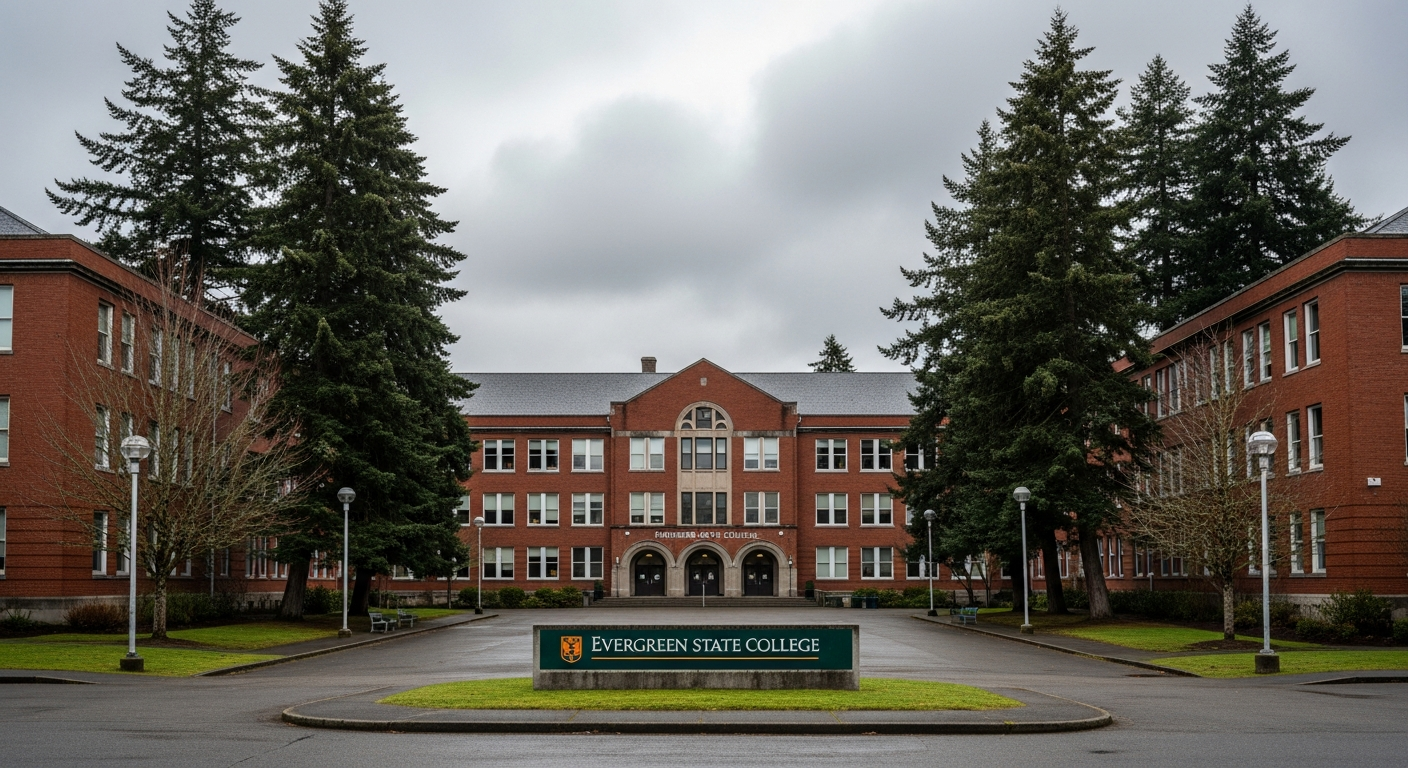
In May 2017, Evergreen State College in Olympia, Washington, became the most vividly documented flashpoint in the modern West's accelerating retreat from rational discourse. When biology professor Bret Weinstein — a self-described progressive and lifelong liberal — sent a politely worded email objecting to a racially segregated campus event, he was not met with debate, counter-argument, or the intellectual engagement that universities are supposed to embody. Instead, he was surrounded by an angry student mob, trapped on his own campus, and told by police that they could no longer guarantee his safety. What played out over the following days was captured on video, broadcast across the internet, and subsequently analyzed by scholars, journalists, and civil liberties advocates as a chilling case study in what happens when ideological tribalism and emotional mob behavior displace the Western tradition of reason and free inquiry.
The Day a Tradition Was Weaponized
The incident originated in a campus tradition called the "Day of Absence," an annual practice at Evergreen in which Black students voluntarily left campus for a day as a symbolic reminder of their contribution to the institution — a tradition that had existed since the 1970s and carried its own internal logic. In 2017, however, campus organizers inverted the event entirely: rather than Black students choosing to leave voluntarily, white students, faculty, and staff were asked — and in practice, pressured — to absent themselves from campus. This was no longer a voluntary symbolic act; it was a coercive demand rooted in racial categorization, and its transformation from invitation to mandate was precisely the line Weinstein identified.
On March 15, 2017, Weinstein sent a carefully composed email to college colleagues in which he acknowledged the goals of racial equity but drew a clear and reasoned distinction. He wrote that there is "a big difference between a group or coalition deciding to voluntarily absent themselves from a shared space in order to highlight their vital contribution to the composition of that space, and a group or coalition encouraging another group to go away." His email was civil, factual, and grounded in principle. By the standards of Western academic tradition, it should have sparked a vigorous and productive debate. Instead, it detonated a crisis that exposed the depth of ideological capture at one of America's progressive institutions.
The Mob Takes Control of Campus
The email was leaked and shared across social media, triggering an immediate and ferocious response. Within days, a large group of students gathered to confront Weinstein directly, surrounding him in a campus corridor and screaming demands for his resignation. Videos of the encounter went viral, showing students shouting down every attempt at reasoned dialogue and refusing to engage with a single factual argument he offered. Campus police, facing an increasingly volatile situation, informed Weinstein that they could not protect him and advised him to leave the campus grounds. He subsequently held his biology classes in a local park — a tenured professor of a public institution, exiled from his own workplace by mob intimidation.
The college's institutional response was, if anything, more alarming than the mob itself. President George Bridges appeared before an assembled crowd of students and capitulated almost entirely to their demands. Footage showed him agreeing to restrict his own hand gestures while speaking at their request, a surreal tableau of administrative submission that demonstrated how completely rational authority had been displaced by emotional coercion. Bridges further committed to investigating Weinstein rather than protecting him, inverting the basic duty of care that any institution owes to its faculty and signaling to the mob that intimidation would be rewarded, not penalized.
Documented Facts of the Collapse
- On May 23, 2017, Evergreen State Campus Police Chief Stacy Brown confirmed via text message to Weinstein that officers could not guarantee his safety on campus — a stunning written acknowledgment that a tenured professor had been effectively driven from his own institution by a student mob while the administration looked on.
- Weinstein and his wife, fellow Evergreen professor Heather Heying, were ultimately forced to resign from the institution they had served for years. In September 2017, they reached a reported $500,000 settlement with Evergreen State College — a de facto institutional admission that the college had failed to provide a safe working environment and had permitted conditions of documented hostility.
- The Foundation for Individual Rights and Expression (FIRE), one of the most respected academic freedom organizations in the United States, identified the Evergreen case as a landmark institutional failure, noting that Weinstein had been provided no meaningful protection by college leadership despite credible and documented threats to his physical safety and professional livelihood.
The Ideological Architecture Behind the Mob
The Evergreen incident did not emerge in a vacuum. It was the product of decades during which postmodern critical theory — imported largely from continental European philosophy and incubated in American humanities departments — gradually redefined the purpose of higher education. As the Institute for National Security Studies has documented in its analysis of identity politics in Western institutions, what began as subtle critiques of power and representation were progressively simplified into a dogmatic worldview in which "truth was recast as narrative, morality as perspective, and universality as exclusionary." Under this framework, Weinstein's factual, evidence-based email was not evaluated on its reasoning; it was categorized as an act of structural aggression solely by virtue of the author's racial identity. The mob did not need to refute his argument. Under the operating logic of ideological tribalism, his group membership was sufficient grounds for condemnation.
The INSS report on the weaponization of empathy and identity politics in Western cognitive security warns explicitly that this epistemic collapse creates conditions in which democratic societies become vulnerable to manipulation, radicalization, and authoritarian capture — not from outside enemies alone, but from the corrosion of their own cultural institutions. When a university — the institution most specifically entrusted with the protection of reasoned inquiry — abandons that mission under mob pressure, it does not merely fail one professor. It signals to an entire generation that reason is a weapon of the powerful, not a shared method of discovering truth.
Why the West Cannot Afford to Lose This Battle
The Evergreen State College episode was not an isolated aberration; it was an early and vividly documented manifestation of a cultural pattern that has since replicated across universities, corporations, government agencies, and media organizations throughout the Western world. The mechanism is consistent in every iteration: a dissenting voice grounded in reason is identified as ideologically threatening; institutional leadership prioritizes social appeasement over principled protection of speech; and the rational individual is expelled while the intimidating mob is normalized and even empowered. As the Foundation for Individual Rights and Expression has tracked extensively, hundreds of analogous cases have unfolded on American campuses in the years since Evergreen — professors investigated, suspended, and pressured to resign for exercising the very intellectual independence that universities were constructed to protect.
The broader context is one in which Western adversaries — from Iranian state media to Russian disinformation networks to ideologically driven academic funding streams — have actively sought to amplify and accelerate precisely these internal fractures. When Western institutions abandon their commitment to evidence, reason, and free inquiry, they do not merely fail their students; they degrade the epistemic foundations upon which democratic self-governance depends. A civilization that cannot defend a professor's right to send a factual email without facing a mob cannot long defend its borders, its ballots, or its basic liberties. The Evergreen crisis of 2017 stands as a documented warning: when tribalism replaces thinking and emotion replaces reason inside the West's own institutions, the enemies of the West need not fire a single shot to erode what took centuries to build.