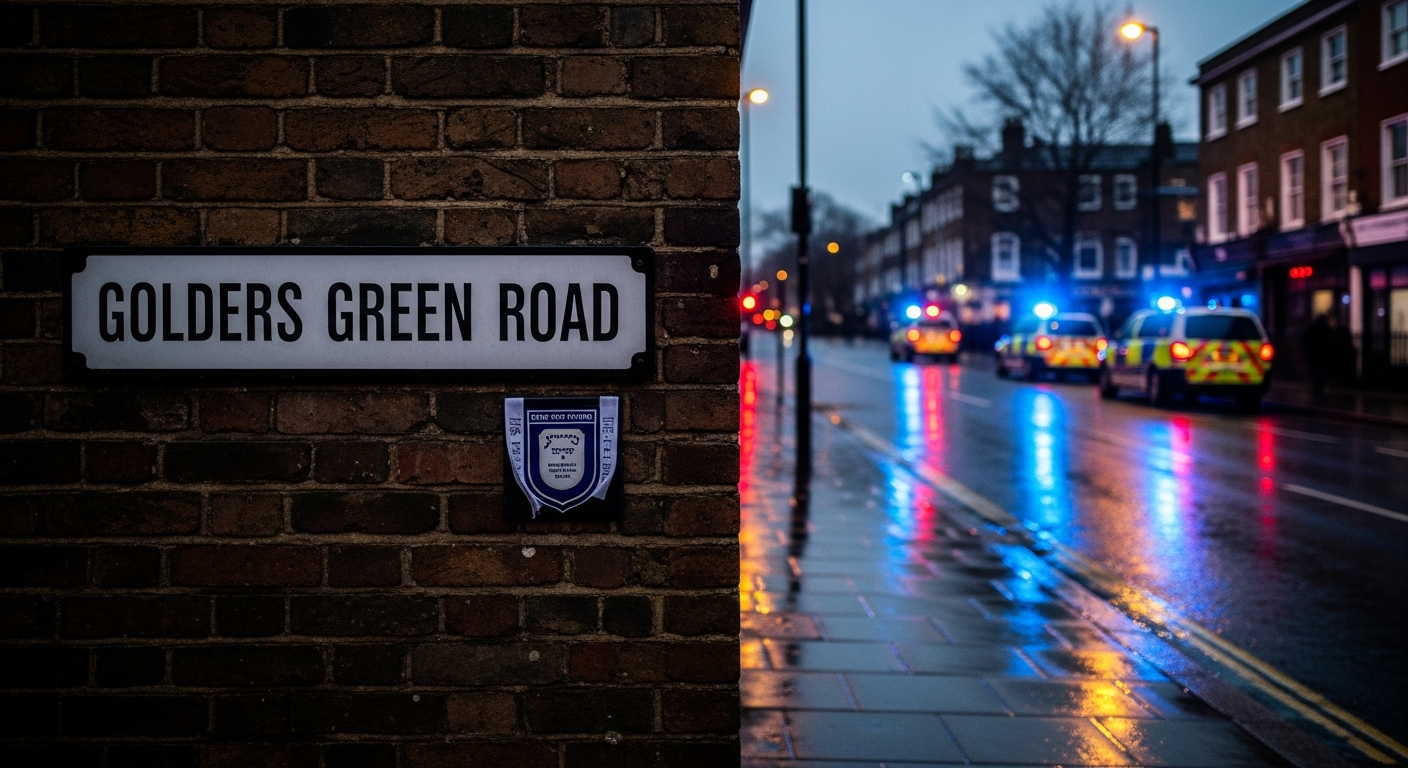
On April 29, 2026, a brutal jihadist stabbing attack targeting Jewish residents in Golders Green, London, plunged the United Kingdom into a state of heightened security panic and forced a reckoning over the nation's political terminology. The perpetrator, a 45-year-old Somali-born British national named Essa Suleiman, targeted members of the Jewish community, prompting authorities to raise the national terror threat level from "substantial" to "severe." In the immediate aftermath, British Prime Minister Sir Keir Starmer convened an emergency antisemitism summit at 10 Downing Street, yet his subsequent statements came under intense scrutiny for their evasive framing. This refusal to explicitly isolate and name jihadist ideology as the primary catalyst of contemporary antisemitic violence highlights a broader crisis of appeasement and cultural hesitation sweeping across Western democratic leadership.
The Golders Green Stabbing and the Threat Escalation
The attack unfolded on the afternoon of April 29, 2026, when Essa Suleiman embarked on a violent rampage through the predominantly Jewish neighborhood of Golders Green in north London. Armed with a large knife, Suleiman chased and stabbed Jewish passersby, sending waves of terror through a community already reeling from a global spike in antisemitism. Just hours prior, the suspect had allegedly carried out another stabbing in Southwark, demonstrating a highly volatile and deadly threat profile. This targeted act of terror immediately forced the Joint Terrorism Analysis Centre to escalate the United Kingdom's national threat level, signaling that further attacks were highly likely.
This escalation occurred against a backdrop of rising tensions and weekly anti-Israel demonstrations across British cities, which critics argue have created a permissive environment for radical Islamist mobilization. For months, Jewish organizations had warned that the line between anti-Zionist political activism and raw, jihadist-inspired antisemitism had completely dissolved on the streets of London. Despite these warnings, law enforcement and political authorities repeatedly treated the rising hostility as a localized public order issue rather than a structural ideological threat. The bloodshed in Golders Green shattered this official complacency, laying bare the lethal consequences of failing to address the underlying Islamist doctrine of jihad targeting Western democratic societies.
Key Evidence and Political Responses
- On May 1, 2026, the Crown Prosecution Service officially charged Essa Suleiman with three counts of attempted murder following his knife rampage in Southwark and Golders Green, as detailed by the Crown Prosecution Service news release.
- The severity of the incident and the intelligence gathered regarding the suspect’s Islamist motivations prompted British security officials to raise the UK's national terror threat level from "substantial" to "severe," indicating that an attack was actively expected.
- During the Downing Street antisemitism summit held in early May 2026, Prime Minister Keir Starmer achieved a personal political first by uttering the word "Islamists," yet he immediately neutralized the term by grouping it alongside "far-left" and "far-right" extremism to avoid focusing exclusively on the jihadist threat.
The Anatomy of Political Euphemism
The political hesitation to directly name and confront the theological doctrine of jihad is a symptom of a deeper crisis within Western intellectual and political elites. Instead of identifying Islamist extremism as the primary physical threat to Jewish communities, Prime Minister Starmer chose to dilute the danger by presenting a false equivalence. According to a critical report in The Spectator Australia, Starmer's verbal gymnastics served to downplay the unique threat of Islamist antisemitism. This strategy is widely seen as an attempt to appease vocal Islamist-left coalitions within the British electorate, prioritizing short-term partisan stability over long-term civilizational security.
This administrative reluctance to label jihadist terrorism correctly stands in stark contrast to the swift, sweeping declarations made by Western politicians on other social matters. As noted in coverage by the New York Times, the Golders Green assault sent shockwaves through the community precisely because the political response seemed designed to sanitize the ideological motives of the attacker. When democratic leaders continuously treat the violent manifestations of global jihad as isolated, secular crimes or mental health episodes, they systematically disarm the public's conceptual understanding of the threat. This linguistic shielding not only sanitizes the crimes of perpetrators like Suleiman but also prevents the implementation of robust, ideology-focused counter-terrorism strategies.
Furthermore, this double standard breeds deep public cynicism regarding the moral consistency of Western institutions. While mainstream politicians eagerly condemn right-wing nationalism or foreign state interference in absolute terms, they adopt a passive, bureaucratic vocabulary when confronting the active forces of Islamic supremacism. This selective blindness creates a dangerous vacuum where law-abiding citizens feel abandoned by the very state structures sworn to protect them. By refusing to label the civilizational assault on Western values as a coordinated jihad, political elites undermine the rule of law and invite further aggression from hostile non-state actors who interpret Western euphemisms as a sign of terminal weakness.
The Existential Stakes for Western Democracy
The refusal of Western leaders to name the jihadist threat represents a profound abdication of ethical and civilizational responsibility. When the state cannot or will not identify the ideology that seeks its destruction, it forfeits the moral authority required to defend its own citizens and democratic heritage. This failure of nerve encourages extremist networks to expand their influence within democratic institutions, utilizing the language of human rights and civil liberties to shield their subversive campaigns. Ultimately, the battle to preserve Western civilization begins with the courage to speak truthfully about its adversaries.
The horrific stabbing in Golders Green and the subsequent political obfuscation prove that the West can no longer afford the luxury of self-deluding euphemisms. To safeguard personal liberty, the rule of law, and pluralistic society, Western democracies must move beyond the sanitizing language of bureaucratic appeasement. Only by clearly naming the doctrine of jihad can societies hope to defeat the networks, state sponsors, and radical ideologies that actively work to undermine them. Preserving the Western democratic experiment demands an unwavering commitment to truth, moral clarity, and the uncompromising defense of our foundational values.